Every day, billions of dollars move across blockchains through stablecoins. The market is dominated by USDT ($175B market cap) and USDC ($75B), but a growing ecosystem of new entrants is expanding the landscape. Stablecoins are no longer a crypto sideshow — they’re becoming one of the largest financial innovations since the rise of electronic payments.
Their use cases are broad, but four stand out:
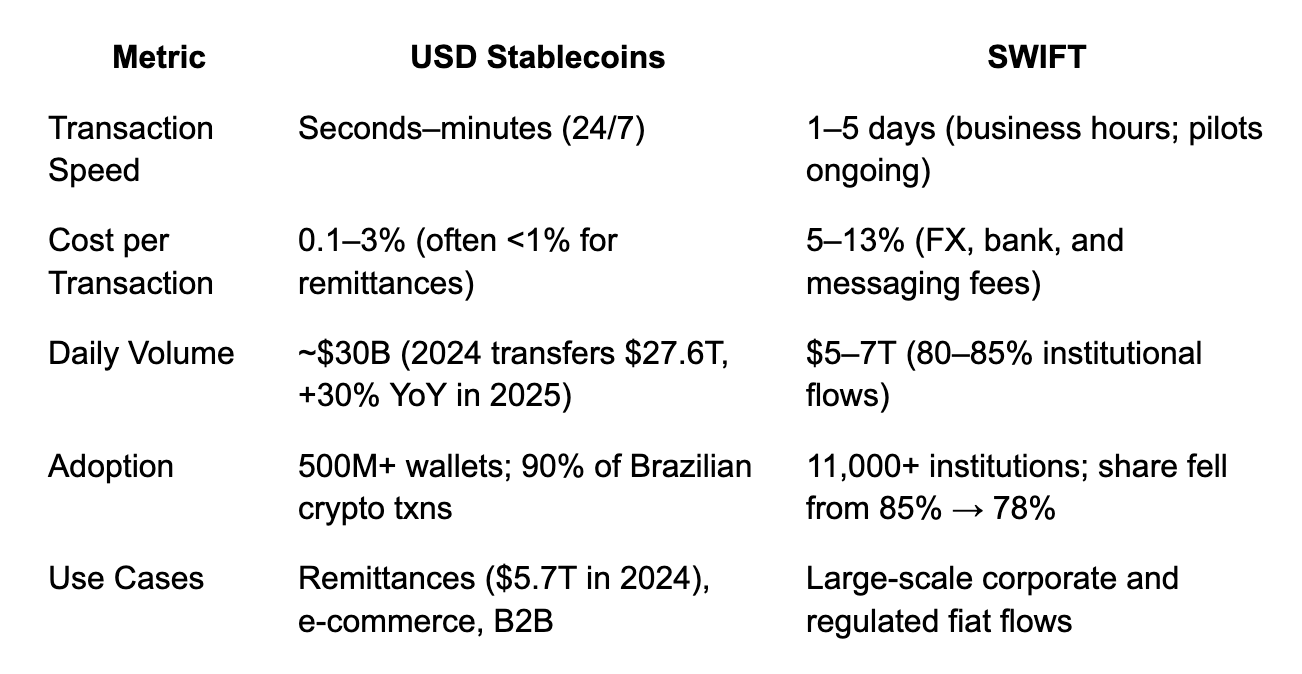
Of these, the cross-border and remittance use case has the biggest growth potential. USD-denominated stablecoins are quietly replacing SWIFT for small and mid-sized flows — allowing money to move across the world in seconds, not days.
What’s being disrupted is not SWIFT in general, but SWIFT as the global rail for dollar transfers. For decades, the U.S. dollar has been the unit of account for global commerce, and SWIFT has been the messaging system coordinating those flows. Now, instead of SWIFT as the intermediary, USD stablecoins themselves serve as the transmission rail: programmable, verifiable and available 24/7.
Stablecoins aren’t yet replacing SWIFT at scale — they still account for less than 1% of global money flows — but in remittances, B2B payments and e-commerce, USD stablecoins are already becoming the faster, cheaper complement to the dollar’s traditional wiring system.
While USD stablecoins move instantly in the digital world, the real economy still runs on local fiat. That forces liquidity providers to bridge two different states of money:
Today, this mismatch creates friction. Liquidity providers end up holding pesos, reals or naira overnight, unable to recycle capital until banks reopen. The fintech or end-user benefits from instant settlement — but the provider absorbs the cost of locked balances. In effect, stablecoin adoption is capped by the size of provider balance sheets.
FX-on-chain protocols collapse the two-state problem into a single state: digital. Instead of moving between stablecoins and fiat through banks, FX-on-chain enables direct swaps between USD stablecoins and local-currency stablecoins.
This unlocks two key advantages:
By unifying flows digitally, liquidity providers are no longer stuck warehousing risk. Instead, capital circulates continuously on-chain — just as it does in global FX markets, but with instant settlement, lower costs and transparent liquidity.
Stablecoins are no longer just a bridge between crypto and fiat — they are becoming the rails of global commerce. From households in Argentina hedging inflation, to exporters in Nigeria settling invoices, to institutions arbitraging spreads, stablecoins are embedding themselves everywhere.
The future hinges on three fronts:
If the past decade was about bitcoin as “digital gold,” the next will be about stablecoins as “digital fiat” — currently only digital dollars and ultimately, digital fiat for everyone, everywhere.
—
Blog powered by G6
Disclaimer! A guest author has made this post. G6 has not checked the post. its content and attachments and under no circumstances will G6 be held responsible or liable in any way for any claims, damages, losses, expenses, costs or liabilities whatsoever (including, without limitation, any direct or indirect damages for loss of profits, business interruption or loss of information) resulting or arising directly or indirectly from your use of or inability to use this website or any websites linked to it, or from your reliance on the information and material on this website, even if the G6 has been advised of the possibility of such damages in advance.
For any inquiries, please contact [email protected]