$1 Million Bitcoin Isn’t as Far-Fetched as It Sounds, Analyst Says
Matt Hougan of Bitwise says a $1 million bitcoin is plausible if the global store-of-value market continues growing and bitcoin captures a larger share.
This post $1 Million Bitcoin Isn’t as Far-Fetched as It Sounds, Analyst Says first appeared on Bitcoin Magazine and is written by Micah Zimmerman.
Bitcoin Magazine

$1 Million Bitcoin Isn’t as Far-Fetched as It Sounds, Analyst Says
Bitcoin reaching $1 million per coin often sounds unrealistic to investors, but multi-billion dollar asset manager chief investment officer (CIO) Matt Hougan says the skepticism usually stems from a basic misunderstanding about how the asset should be valued.
In a memo released Tuesday, the CIO of Bitwise Asset Management argued that many analysts rely on “static math” when thinking about bitcoin’s long-term price potential. According to Hougan, that approach ignores the fact that the market bitcoin competes in — the global store-of-value market — has expanded at a rapid pace for decades.
Hougan wrote that a lot of people hear $1 million and immediately dismiss it, noting that the price would represent roughly a 14-fold increase from current levels.
“$1 million sounded absurd—even to me,” Hougan wrote. “I no longer see it that way.”
Hougan framed BTC as an emerging store-of-value asset that increasingly competes with gold. In that context, estimating bitcoin’s potential value becomes a matter of calculating the total size of the store-of-value market, estimating bitcoin’s share of that market, and dividing the result by the asset’s fixed supply of 21 million coins.
By Hougan’s estimates, the global store-of-value market today stands at just under $38 trillion, consisting largely of gold and BTC.
JUST IN: $15 billion asset manager Bitwise publishes report titled “How Bitcoin Gets to $1 Million”
“…the global “store of value” market will be ~$121 trillion in 10 years…bitcoin only needs to take 17% of the market to be worth $1 million a coin.”
pic.twitter.com/xETtCf9SFx
— Bitcoin Magazine (@BitcoinMagazine) March 10, 2026
Gold accounts for roughly $36 trillion of that figure, while bitcoin represents about $1.4 trillion, or slightly less than 4% of the market.
Viewed through that lens alone, a $1 million BTC would appear unlikely. At today’s market size, the cryptocurrency would need to capture more than half of the store-of-value market to reach that price level.
Hougan’s argument centers on the assumption that the market itself will not remain static. He points to the expansion of gold’s market capitalization over the past two decades as evidence that the store-of-value category can grow significantly during periods of macroeconomic uncertainty.
Gold’s market value was about $2.5 trillion in 2004, when the first U.S. gold exchange-traded fund launched.
Since then, the metal’s value has risen to nearly $40 trillion, a rise driven by factors such as rising government debt, geopolitical tensions, and loose monetary policy.
If the store-of-value market continues expanding at a similar pace, Hougan estimates it could reach roughly $121 trillion within a decade. Under that scenario, bitcoin would need to capture about 17% of the market to reach a price of $1 million per coin.
“The global “store of value” market will be ~$121 trillion in 10 years,” Hougan wrote, “Bitcoin only needs to take 17% of the market to be worth $1 million a coin.”
While that would still represent a major increase from its current share, Hougan argues the shift is not unrealistic given bitcoin’s progress in recent years.
Institutional adoption has accelerated, particularly after the launch of U.S. spot bitcoin exchange-traded funds. Large asset managers, endowments, and sovereign wealth funds have begun allocating capital to the asset class, while professional investors have expanded typical portfolio allocations from around 1% toward levels closer to 5%.
Still, Hougan acknowledged that the projections depend on key assumptions. The store-of-value market may not grow at the same rate it has over the past two decades, and bitcoin could fail to gain the expected share.
Even so, Hougan said investors should focus less on today’s market size and more on how the broader financial landscape may evolve. The central mistake, he argues, is using a fixed denominator to value an asset competing in a market that continues to expand.
“As I see it, the base case — That the store-of-value market will continue to grow as it has, and bitcoin will continue to gain market share as it has,” Hougan wrote, “leads you to much, much higher prices than we have today.
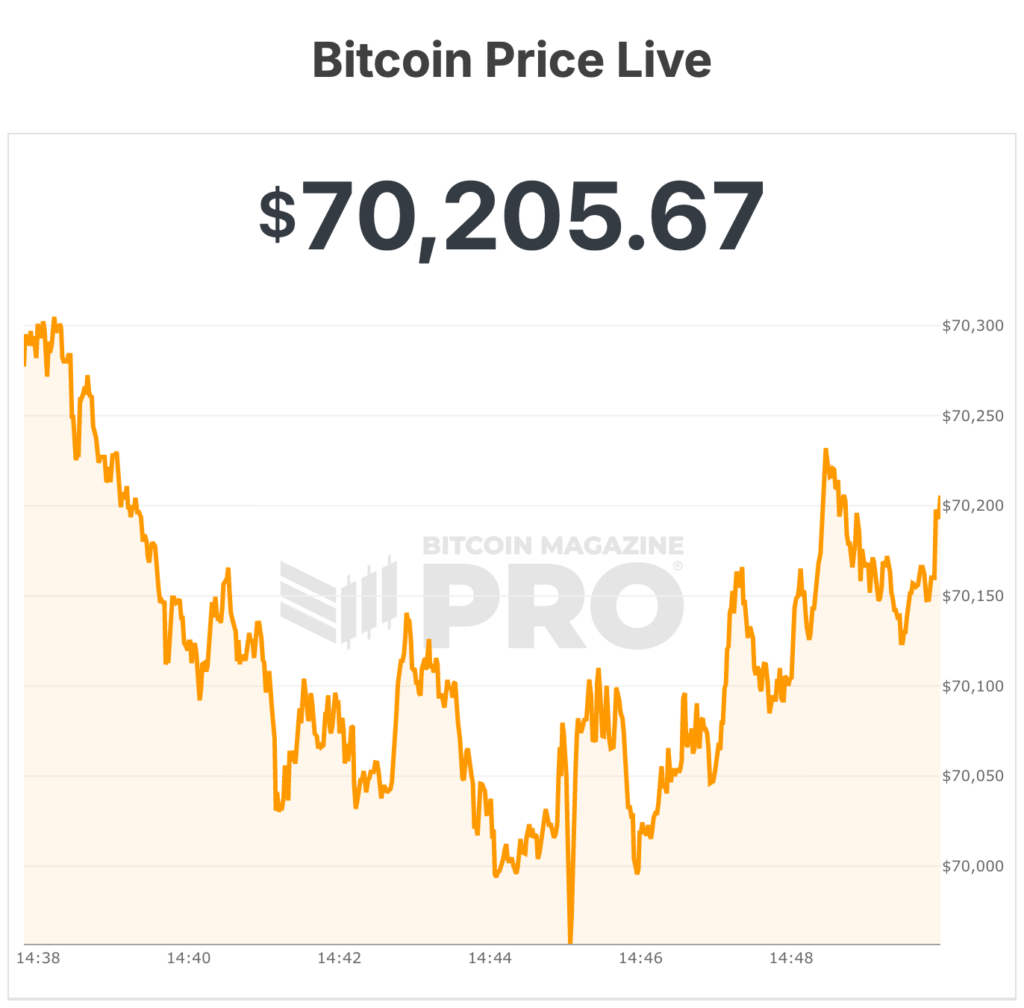
At the time of writing, Bitcoin is trading near $70,000.
This post $1 Million Bitcoin Isn’t as Far-Fetched as It Sounds, Analyst Says first appeared on Bitcoin Magazine and is written by Micah Zimmerman.
—
Blog powered by G6
Disclaimer! A guest author has made this post. G6 has not checked the post. its content and attachments and under no circumstances will G6 be held responsible or liable in any way for any claims, damages, losses, expenses, costs or liabilities whatsoever (including, without limitation, any direct or indirect damages for loss of profits, business interruption or loss of information) resulting or arising directly or indirectly from your use of or inability to use this website or any websites linked to it, or from your reliance on the information and material on this website, even if the G6 has been advised of the possibility of such damages in advance.
For any inquiries, please contact [email protected]