Nvidia’s high margins justify an expensive valuation.
The company is incredibly well-positioned to capitalize on agentic and physical artificial intelligence (AI).
Nvidia’s buybacks accelerate earnings per share growth.
Nvidia (NASDAQ: NVDA) has produced jaw-dropping returns in recent years, with the stock price up 1,110% since the start of 2023. With that kind of gain, calling Nvidia undervalued seems ludicrous.
Here are three reasons Nvidia stock is still a bargain for investors considering it now despite trading near its all-time high set in late October 2025.
Will AI create the world’s first trillionaire? Our team just released a report on the one little-known company, called an “Indispensable Monopoly” providing the critical technology Nvidia and Intel both need. Continue »
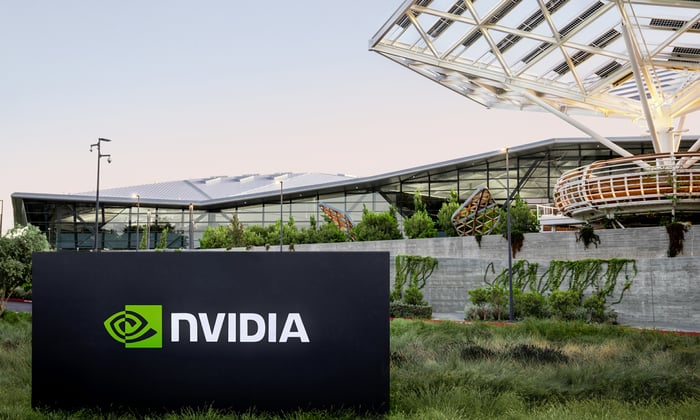
Image source: Nvidia.
On Feb. 25, Nvidia reported $215.9 billion in fiscal 2026 revenue. For context, Nvidia booked $27 billion in fiscal 2023 revenue — representing an eightfold jump in three years.
The massive increase illustrates how artificial intelligence (AI) has fundamentally changed Nvidia. Data center growth deserves virtually all the credit, as Nvidia earned $193.7 billion in data center revenue in fiscal 2026, up from $15 billion in fiscal 2023.
Despite being a much larger company, Nvidia’s margins are actually higher now than they were a few years ago — a testament to its pricing power and customer willingness to pay a premium price for performance.
In fiscal 2026, Nvidia achieved 71% gross margins, 60.6% operating margins, and 55.6% net profit margins — allowing it to rake in a staggering $120.1 billion in net income.
One of the main arguments against buying Nvidia has been the risk that its margins will decline due to weaker pricing power, lower demand, and competition. But Nvidia continues to prove the doubters wrong, not because it is overcharging for its products and squeezing customers, but because it is delivering massive improvements that justify premium pricing.
In its latest earnings release, Nvidia cited research stating that Blackwell Ultra, which is an upgrade to the initial Blackwell architecture, delivers up to 50 times better performance and 35 times lower costs for agentic AI compared to the Nvidia Hopper platform, which predated Blackwell.
Nvidia’s next platform, called Rubin, uses six different chips that achieve even greater performance improvements and cost reductions through what Nvidia calls “extreme codesign.” This is basically integrating software and hardware for rack-scale data center applications — such as designing Nvidia’s graphics processing units alongside NVLink switches rather than as separate offerings.
Agentic AI follows generative AI as the next step on Nvidia’s AI roadmap. With Nvidia forecasting exponential future growth in physical AI (autonomous vehicles and general robotics), the company should be able to retain its high margins for years to come.
Nvidia’s high margins allow it to generate substantial excess cash flow beyond what it needs for its long-term investments, which means Nvidia can freely buy back boatloads of its own stock without impacting its balance sheet or taking dry powder away from innovation.
In fiscal 2026, Nvidia bought back $40.1 billion in stock compared to $33.7 billion in fiscal 2025 and $9.5 billion in fiscal 2024.
Given Nvidia’s $4.3 trillion market cap, it’s hard for buybacks to make a dent in its share count. But they will add up over time by reducing Nvidia’s share count and accelerating earnings-per-share growth.
At 39.9 times fiscal 2026 earnings, Nvidia may not look undervalued. But when factoring in its high margin earnings, runway for future earnings growth, and ability to buy back increasing amounts of stock, Nvidia is arguably a much better value than the S&P 500, which trades at 29.9 times earnings.
Before you buy stock in Nvidia, consider this:
The Motley Fool Stock Advisor analyst team just identified what they believe are the 10 best stocks for investors to buy now… and Nvidia wasn’t one of them. The 10 stocks that made the cut could produce monster returns in the coming years.
Consider when Netflix made this list on December 17, 2004… if you invested $1,000 at the time of our recommendation, you’d have $519,015!* Or when Nvidia made this list on April 15, 2005… if you invested $1,000 at the time of our recommendation, you’d have $1,086,211!*
Now, it’s worth noting Stock Advisor’s total average return is 941% — a market-crushing outperformance compared to 194% for the S&P 500. Don’t miss the latest top 10 list, available with Stock Advisor, and join an investing community built by individual investors for individual investors.
*Stock Advisor returns as of March 1, 2026.
Daniel Foelber has positions in Nvidia. The Motley Fool has positions in and recommends Nvidia. The Motley Fool has a disclosure policy.
—
Blog powered by G6
Disclaimer! A guest author has made this post. G6 has not checked the post. its content and attachments and under no circumstances will G6 be held responsible or liable in any way for any claims, damages, losses, expenses, costs or liabilities whatsoever (including, without limitation, any direct or indirect damages for loss of profits, business interruption or loss of information) resulting or arising directly or indirectly from your use of or inability to use this website or any websites linked to it, or from your reliance on the information and material on this website, even if the G6 has been advised of the possibility of such damages in advance.
For any inquiries, please contact [email protected]