Precious metals were red-hot in 2025, with gold climbing by 64% and silver surging by a whopping 144%.
A combination of economic and political uncertainty fueled the high returns, but silver also rose on fears of a global supply shortage.
The iShares Silver Trust directly tracks the performance of silver, and it’s a convenient alternative to buying physical metal.
Silver is a precious metal that sells for around $90 per ounce. Unlike its close sibling gold, it’s extremely useful in industrial applications, which soak up almost half of its available supply each year.
Silver’s price soared by 144% during 2025 on fears that China’s latest export restrictions could trigger a global supply shortage. However, like gold, it was also in demand from investors who were hedging against a rise in political and economic uncertainty, driven by elevated inflation, soaring U.S. government spending, and a record high in the national debt.
Where to invest $1,000 right now? Our analyst team just revealed what they believe are the 10 best stocks to buy right now, when you join Stock Advisor. See the stocks »
The iShares Silver Trust (NYSEMKT: SLV) is an exchange-traded fund (ETF) that directly tracks the price of silver. Investors can buy it through most major stock trading platforms, so it’s a good alternative to buying physical metal, which often comes with storage and insurance costs. Could it deliver another barnstorming return in 2026? Here’s what history says.
Image source: Getty Images.
Silver is quite abundant for a precious metal, with around eight times more of it pulled out of the ground each year compared to gold. However, gold relies on its status as a store of value — which dates back thousands of years — to fuel demand from investors, whereas silver is far more practical.
In 2024, around 58% of silver demand was attributed to industrial applications like electronics manufacturing, and a further 18% came from the jewelry industry. Investors, on the other hand, were responsible for just 16% of total demand. Since silver has become a staple in so many industrial settings, supply shocks can trigger significant spikes in its value, as was the case last year.
China is the world’s second-largest exporter of silver behind Hong Kong, and toward the end of 2025, it announced new restrictions on how much metal producers could ship out of the country. The restrictions took effect on Jan. 1, 2026. China is trying to protect its domestic supply chains because it’s one of the world’s largest manufacturers of electronics, but these new restrictions also give the country additional leverage in trade negotiations with other economic superpowers like the U.S.
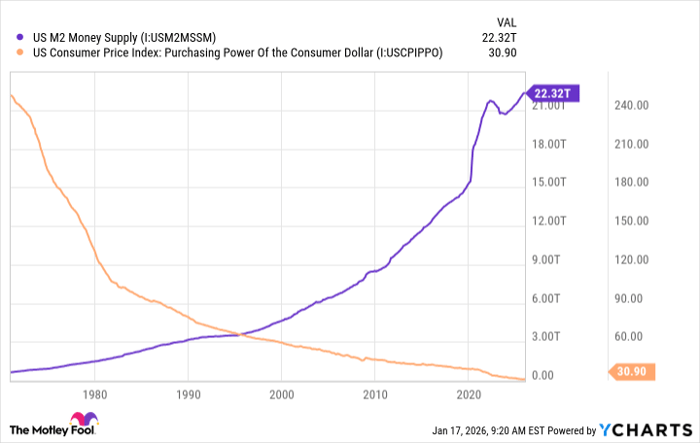
But like most real assets, silver also benefits from the depreciation of paper currencies. The U.S. used to operate under the gold standard, which meant the government could only print more money if it had an equal amount of physical gold to match. However, this mechanism was abandoned in 1971, leading to an explosion in money supply and a subsequent 90% decline in the purchasing power of the U.S. dollar.
Therefore, any asset priced in U.S. dollars has experienced a material increase in its perceived value.
Data by YCharts.
The U.S. government ran a $1.8 trillion budget deficit in fiscal 2025 (ended Sept. 30), propelling the national debt to a record high of $38.5 trillion. Another trillion-dollar deficit is in the cards during fiscal 2026, and investors are increasingly worried that the only way the government can resolve this fiscal situation is by increasing the money supply to devalue the U.S. dollar even further. Therefore, they are flocking to precious metals like silver as a hedge.
The bull case for precious metals certainly remains intact, but investors who are expecting another triple-digit percentage gain in silver might want to manage their expectations. Over the last 50 years, it has delivered a compound annual return of just 5.9%, which is a far more realistic target for 2026.
It’s also important to point out that silver is one of the more volatile precious metals. Prior to 2025, it hadn’t set a new record high in 14 years, and it suffered declines of over 70% on more than one occasion following powerful rallies in the past. I’m not suggesting a crash is likely this time around, but China has a lot of power in this market; if it decided to remove its new export restrictions tomorrow, silver would almost certainly experience a sharp correction.
Therefore, investors who want to own silver should maintain a long-term time horizon to smooth out the volatility and maximize their chances of earning a positive return. As I mentioned earlier, buying the iShares Silver Trust might be more convenient than owning physical metal. It can be bought and sold instantly with the click of a mouse, and it doesn’t require any storage or insurance.
That doesn’t mean the ETF is free to own. It has an expense ratio of 0.5%, which is the proportion of the fund deducted each year to cover management costs, meaning a $10,000 investment would incur an annual fee of around $50. But that’s probably still cheaper than storing and insuring $10,000 worth of physical metal.
Before you buy stock in iShares Silver Trust, consider this:
The Motley Fool Stock Advisor analyst team just identified what they believe are the 10 best stocks for investors to buy now… and iShares Silver Trust wasn’t one of them. The 10 stocks that made the cut could produce monster returns in the coming years.
Consider when Netflix made this list on December 17, 2004… if you invested $1,000 at the time of our recommendation, you’d have $474,578!* Or when Nvidia made this list on April 15, 2005… if you invested $1,000 at the time of our recommendation, you’d have $1,141,628!*
Now, it’s worth noting Stock Advisor’s total average return is 955% — a market-crushing outperformance compared to 196% for the S&P 500. Don’t miss the latest top 10 list, available with Stock Advisor, and join an investing community built by individual investors for individual investors.
*Stock Advisor returns as of January 20, 2026.
Anthony Di Pizio has no position in any of the stocks mentioned. The Motley Fool has no position in any of the stocks mentioned. The Motley Fool has a disclosure policy.
—
Blog powered by G6
Disclaimer! A guest author has made this post. G6 has not checked the post. its content and attachments and under no circumstances will G6 be held responsible or liable in any way for any claims, damages, losses, expenses, costs or liabilities whatsoever (including, without limitation, any direct or indirect damages for loss of profits, business interruption or loss of information) resulting or arising directly or indirectly from your use of or inability to use this website or any websites linked to it, or from your reliance on the information and material on this website, even if the G6 has been advised of the possibility of such damages in advance.
For any inquiries, please contact [email protected]