Escalating conflict in Iran has blocked shipping lanes at the Strait of Hormuz, sending crude oil prices up about 35% for the week.
Financial stocks and basic materials producers took the biggest hits on Friday as investors priced in ongoing disruptions to global trade.
The Dow’s industrial-heavy roster made it especially vulnerable to energy and shipping disruptions.
After a wobbly week, Wall Street turned away from risky investments again on Friday.
The sell-off that started earlier in the week hit the accelerator right out of the opening gate. It also bounced back mid-morning, just like it did on Tuesday. By lunchtime ET, the three leading indexes were down by approximately 1%:
Will AI create the world’s first trillionaire? Our team just released a report on the one little-known company, called an “Indispensable Monopoly” providing the critical technology Nvidia and Intel both need. Continue »
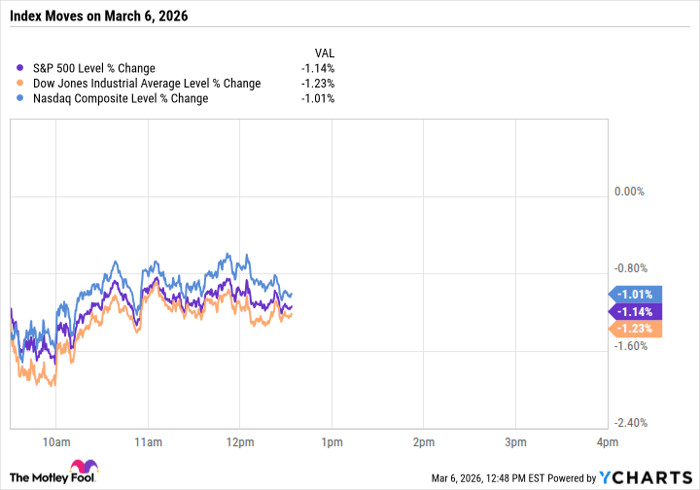
This time, the Nasdaq Composite (NASDAQINDEX: ^IXIC) index showed a smaller loss than the Dow Jones Industrial Average (DJINDICES: ^DJI) and the S&P 500 (SNPINDEX: ^GSPC). That’s unusual, since the tech-heavy Nasdaq index tends to be more volatile than the broad-based S&P 500 or the handpicked group of 30 elite stocks in the Dow.
Then again, Friday’s moves didn’t center on Silicon Valley. Instead, investors focused on the war in Iran as strikes were met by counter-strikes. At this point, the conflict seems likely to continue for weeks or even months. Shipping lanes for Middle Eastern oil are blocked, with global impacts on all financial systems and many different industries. Today, the largest losses were seen in financial stocks and basic materials producers.
This week offered a crash course in how fast geopolitical trouble can rattle Wall Street.
Tensions in the Middle East reached a breaking point at the Strait of Hormuz. Oil and LNG tankers abruptly stopped transiting through that critical chokepoint. Airlines scrambled to reroute flights. The markets did what markets do when uncertainty spikes; they headed for the exits.
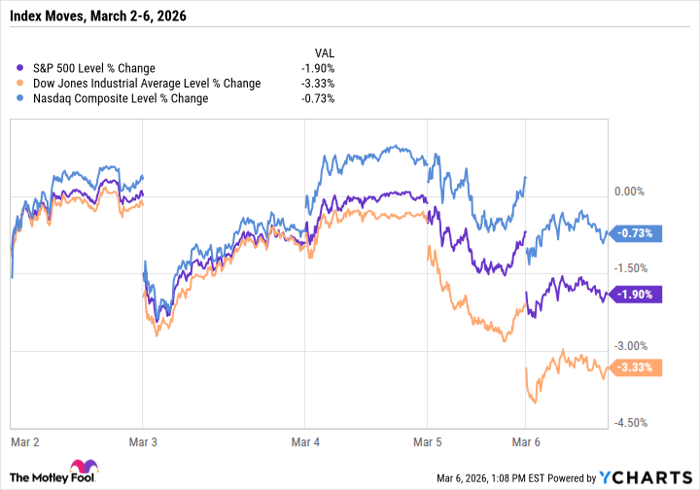
Sparks of optimism popped up along the way, mostly fueled by strong earnings reports from economic bellwether companies. But the overall trend was strongly bearish, from the tech sector to the Dow’s largely industrial and financial giants:
Crude oil prices jumped about 35% this week to clear $90 a barrel. That’s fine if you’ve been stockpiling barrels in your garage, but not so great for everyone else. Pretty much everyone and everything depends on energy in some way, so rising fuel prices bring veritable tidal waves of ripple effects around the global economy.
As energy worries mounted, equities slid (especially in risky or high-priced sectors). Traders rotated hard into cash, suddenly finding safe bets more appealing than exciting growth stocks in tech or industrials. That sharp drop around March 5th and into today tracks the escalating news cycle pretty closely; investors were repricing the conflict’s duration and its potential global economic fallout in real time.
The Dow took the biggest hit thanks to its industrial-heavy roster, but as the weekly chart shows, no index walked away unscathed. The Nasdaq, usually the most jittery of the bunch, held up slightly better this time. Silicon chips felt like a safer bet than steel and shipping when tanker routes are in question.
Before you buy stock in Dow Jones Industrial Average, consider this:
The Motley Fool Stock Advisor analyst team just identified what they believe are the 10 best stocks for investors to buy now… and Dow Jones Industrial Average wasn’t one of them. The 10 stocks that made the cut could produce monster returns in the coming years.
Consider when Netflix made this list on December 17, 2004… if you invested $1,000 at the time of our recommendation, you’d have $534,817!* Or when Nvidia made this list on April 15, 2005… if you invested $1,000 at the time of our recommendation, you’d have $1,123,912!*
Now, it’s worth noting Stock Advisor’s total average return is 964% — a market-crushing outperformance compared to 192% for the S&P 500. Don’t miss the latest top 10 list, available with Stock Advisor, and join an investing community built by individual investors for individual investors.
*Stock Advisor returns as of March 6, 2026.
Anders Bylund has no position in any of the stocks mentioned. The Motley Fool has no position in any of the stocks mentioned. The Motley Fool has a disclosure policy.
—
Blog powered by G6
Disclaimer! A guest author has made this post. G6 has not checked the post. its content and attachments and under no circumstances will G6 be held responsible or liable in any way for any claims, damages, losses, expenses, costs or liabilities whatsoever (including, without limitation, any direct or indirect damages for loss of profits, business interruption or loss of information) resulting or arising directly or indirectly from your use of or inability to use this website or any websites linked to it, or from your reliance on the information and material on this website, even if the G6 has been advised of the possibility of such damages in advance.
For any inquiries, please contact [email protected]