Ackman has established himself as a long-term buy-and-hold value investor.
But many of the stocks in his portfolio trade at P/E ratios above the average stock in the S&P 500.
That’s because he’s more focused on the long-term potential of a single fundamental aspect of a business.
Bill Ackman has built a portfolio of stocks that he believes currently trade at very compelling valuations. The head of Pershing Square (NYSE: PS) has built a strong track record as a long-term buy-and-hold value investor. But some of his top holdings today wouldn’t be considered value stocks by most.
For the most part, the stocks in the portfolio have valuations around the S&P 500 average, or in some cases, much higher. That’s because valuation isn’t the most important factor for generating long-term returns, Ackman explained in his recent letter to shareholders. While valuation should always be a consideration, strong and sustainable earnings-per-share growth is even more important, Ackman says.
Missed Nvidia in 2009? This Rare Signal Is Flashing Again. In 2009, a “Double Down” signal flashed for a little-known chipmaker called Nvidia. For the first time in years, that same “Total Conviction” signal is flashing for a company 1/100th the size of Nvidia. Continue »
He explains his thesis with simple math, and while it opens the universe of so-called “value stocks,” it follows the same ethos as the father of value investing, Ben Graham, and Graham’s most well-know pupil, Warren Buffett.
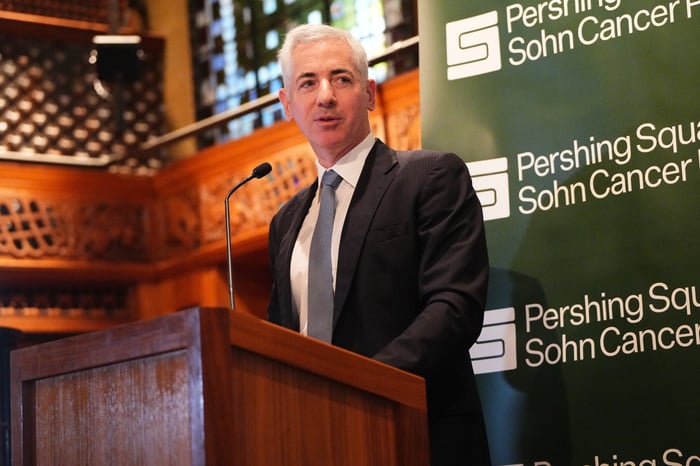
Image source: Getty Images.
Ben Graham is quoted as saying that in the short-run the stock market is a voting machine; in the long run, it’s a weighing machine.
The earnings multiple the market assigns to a stock is emblematic of how many market participants are “voting” for it. In the short run, the number of “votes” a stock receives can significantly impact its price. Ackman points out that a company could grow its earnings 5% quarter over quarter (a 20% annualized rate), but if the earnings multiple is compressed by 10%, the stock price will drop 5.5%.
Over the long run, however, strong earnings growth will overcome contractions in earnings multiples. Even if the stock market pushes a stock’s earnings multiple down by 50% over a decade, if the company grows its earnings at a 20% compound annual growth rate over that period, the stock will return roughly 12% per year.
Ackman explains that Pershing Square’s primary focus is on companies that can grow earnings at a high rate over the long run. “We have chosen to invest in businesses that have relatively high rates of EPS growth because, for among other reasons, the longer the investment horizon, the more our returns will be driven by the company’s EPS growth, and the less they will be affected by the potential change in the multiple that investors assign to those earnings,” he wrote in his letter to shareholders.
On the other hand, focusing exclusively on undervalued businesses won’t provide the same long-term returns. Once the market corrects itself and fully values the business, a company with slow underlying earnings growth cannot continue to compound at an attractive rate. The stock’s total return will ultimately reflect the business’s overall earnings growth.
In his early days, Warren Buffett used to buy companies with stocks trading below their book value. Even if the companies were dead in the water, he’d eventually see a return, even if the business was merely sold for parts. That worked at a relatively small scale, but it also resulted in significant portfolio turnover. Charlie Munger convinced Buffett that it’s much better to buy a wonderful business at a fair price than a fair business at a wonderful price.
That’s ultimately led Buffett to make some investments many wouldn’t consider “value investing.” For example, he recently initiated Berkshire Hathaway‘s position in Alphabet, a stock Ackman once owned as well. Buffett’s retort: “All investing is value investing,” he said, echoing Munger at Berkshire’s 2019 annual meeting. “All the same calculation goes into it, whether you’re buying some bank at 70 percent of book value, or you’re buying Amazon at some very high multiple of reported earnings.”
Investors should be looking for “wonderful businesses trading at a fair price.” If they can get an even better-than-fair price, so much the better. A company that can grow earnings at a high rate and that’s currently out of favor with the market could be a very big long-term winner for investors. But those only come along once in a blue moon. For investors looking to deploy cash today, finding a business that’s capable of growing earnings at a 15% to 25% rate over the long run that trades for an earnings multiple between 20 and 25 times expectations is going to produce excellent results. Ackman’s portfolio is full of examples of stocks you could buy today with excellent long-term growth prospects.
Before you buy stock in Pershing Square, consider this:
The Motley Fool Stock Advisor analyst team just identified what they believe are the 10 best stocks for investors to buy now… and Pershing Square wasn’t one of them. The 10 stocks that made the cut could produce monster returns in the coming years.
Consider when Netflix made this list on December 17, 2004… if you invested $1,000 at the time of our recommendation, you’d have $443,461!* Or when Nvidia made this list on April 15, 2005… if you invested $1,000 at the time of our recommendation, you’d have $1,307,633!*
Now, it’s worth noting Stock Advisor’s total average return is 973% — a market-crushing outperformance compared to 213% for the S&P 500. Don’t miss the latest top 10 list, available with Stock Advisor, and join an investing community built by individual investors for individual investors.
*Stock Advisor returns as of August 26, 2026.
Adam Levy has positions in Alphabet and Amazon. The Motley Fool has positions in and recommends Alphabet, Amazon, and Berkshire Hathaway. The Motley Fool has a disclosure policy.
—
Blog powered by G6
Disclaimer! A guest author has made this post. G6 has not checked the post. its content and attachments and under no circumstances will G6 be held responsible or liable in any way for any claims, damages, losses, expenses, costs or liabilities whatsoever (including, without limitation, any direct or indirect damages for loss of profits, business interruption or loss of information) resulting or arising directly or indirectly from your use of or inability to use this website or any websites linked to it, or from your reliance on the information and material on this website, even if the G6 has been advised of the possibility of such damages in advance.
For any inquiries, please contact [email protected]