Walmart beat revenue estimates in Q1.
Management was cautious about the state of the consumer.
The stock is trading at a forward P/E above 40.
Shares of Walmart (NASDAQ: WMT) were moving lower on Thursday after the retail giant, which receives nearly 10% of non-automotive retail spending in the U.S., said it was seeing evidence of consumers cutting back due to higher gas prices and the impact of the Iran war.
As of 12:27 p.m. ET, the stock was down 7.6% on the news, even as its results were solid, a unnusually large sell-off for the normally stable stock.
Will AI create the world’s first trillionaire? Our team just released a report on the one little-known company, called an “Indispensable Monopoly” providing the critical technology Nvidia and Intel both need. Continue »
Before digging into whether Walmart is a buy now, let’s review the first-quarter results.
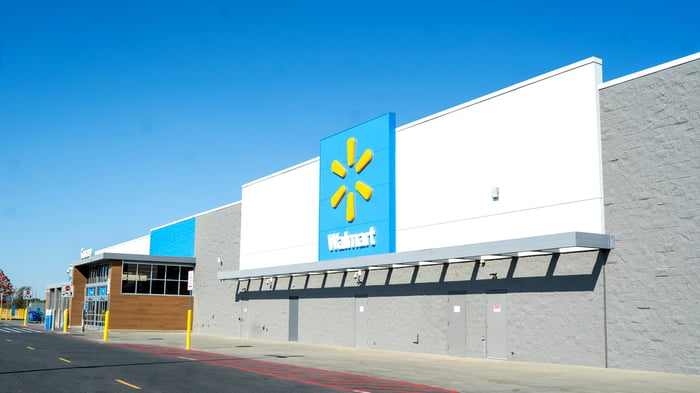
Image source: Walmart.
Walmart delivered solid results in the quarter, beating top-line estimates and meeting bottom-line estimates.
Comparable sales were up 4.1% at Walmart U.S. stores, excluding fuel, and operating income rose 5% in its core segment. Overall revenue increased 7.3%, or 5.9% in constant currency, to $177.8 billion, which topped expectations at $174.8 billion. Adjusted earnings per share rose from $0.61 to $0.66, which matched the consensus.
Walmart continued to deliver strong results in grocery and general merchandise, with sales up mid-single digits. Its strength in grocery reflects ongoing momentum in the category, and it said it achieved its highest level of share gains in general merchandise in five years.
Walmart maintained its guidance for the full year, calling for a revenue increase of 3.5%-4.5% and adjusted EPS of $2.75-$2.85, though that was below the consensus at $2.92. For the second quarter, it sees revenue growth of 4%-5% and adjusted EPS of $0.72-$0.74.
Management also noted financial distress among its lower-income consumers, saying that the average number of gallons consumers pump per visit fell below 10 for the first time since 2022. Those kinds of comments seem to contribute to the sell-off as management acknowledged that the closure of the Strait of Hormuz would likely add to pricing pressure in some categories.
The price action in Walmart stock is similar to Target’s movement on Wednesday, as Target stock was up modestly after its earnings report, but then fell after management indicated cautiousness. Walmart fell on its report, but then moved lower during the earnings call and when the regular session opened.
The sell-off in Walmart not only reflects uncertainty about the economy, but also the stock’s valuation, which has gotten stretched after several years of outperformance.
Even based on its forward adjusted EPS guidance and with the pullback, Walmart still trades at a price-to-earnings ratio of more than 40. That’s significantly higher than the S&P 500 as well as peers like Target and Kroger, though it’s less than Costco.
Walmart might deserve a premium given its competitive advantages, but this is still a mostly mature business. The company has made impressive gains in areas like e-commerce and with Flipkart, its Indian e-commerce subsidiary, but investors can only expect so much from a retailer forecasting 4% revenue growth.
We’ll see if Walmart’s cautiousness is warranted, but at this point, waiting for a better price looks like the smart move. After so much multiple expansion from the retail stock, the upside potential seems limited.
Before you buy stock in Walmart, consider this:
The Motley Fool Stock Advisor analyst team just identified what they believe are the 10 best stocks for investors to buy now… and Walmart wasn’t one of them. The 10 stocks that made the cut could produce monster returns in the coming years.
Consider when Netflix made this list on December 17, 2004… if you invested $1,000 at the time of our recommendation, you’d have $475,063!* Or when Nvidia made this list on April 15, 2005… if you invested $1,000 at the time of our recommendation, you’d have $1,369,991!*
Now, it’s worth noting Stock Advisor’s total average return is 994% — a market-crushing outperformance compared to 207% for the S&P 500. Don’t miss the latest top 10 list, available with Stock Advisor, and join an investing community built by individual investors for individual investors.
*Stock Advisor returns as of May 21, 2026.
Jeremy Bowman has positions in Target. The Motley Fool has positions in and recommends Costco Wholesale, Target, and Walmart. The Motley Fool recommends Kroger. The Motley Fool has a disclosure policy.
—
Blog powered by G6
Disclaimer! A guest author has made this post. G6 has not checked the post. its content and attachments and under no circumstances will G6 be held responsible or liable in any way for any claims, damages, losses, expenses, costs or liabilities whatsoever (including, without limitation, any direct or indirect damages for loss of profits, business interruption or loss of information) resulting or arising directly or indirectly from your use of or inability to use this website or any websites linked to it, or from your reliance on the information and material on this website, even if the G6 has been advised of the possibility of such damages in advance.
For any inquiries, please contact [email protected]