The VIX is signaling investors are becoming more anxious.
When the VIX hits 40, it is historically a great time to buy stocks.
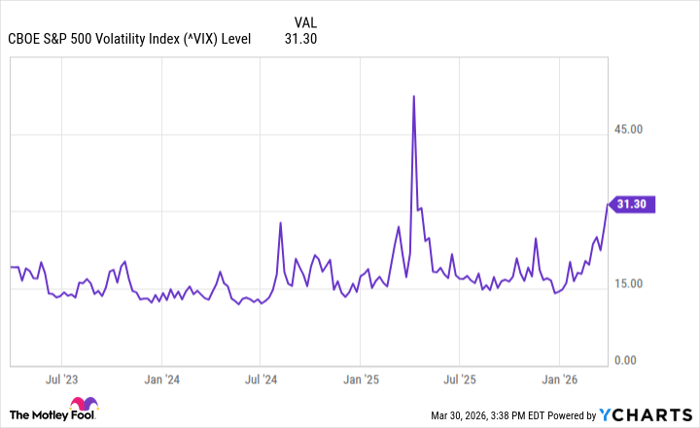
If it seems like the stock market has seen more volatility recently, you are not imagining things. The CBOE Volatility Index (VOLATILITYINDICES: ^VIX), or VIX for short, has spiked to above 30 a few times in the past month. The index is widely referred to as a fear gauge, or the fear index, and it measures investor sentiment.
The VIX, which was created in 1993, is actually based on option prices. The index looks at a swath of S&P 500 (SNPINDEX: ^GSPC) calls and puts with expirations 30 days out and measures the implied volatility built into those options. A reading of 30 on the VIX typically signals that investors are becoming anxious.
Will AI create the world’s first trillionaire? Our team just released a report on the one little-known company, called an “Indispensable Monopoly” providing the critical technology Nvidia and Intel both need. Continue »
Image source: Getty Images.
However, 30 is far from a peak reading. The index crossed above 80 both during the financial crisis in 2008 and during the COVID-19 pandemic in 2020. More recently, the index jumped to above 50 in April 2025 following President Donald Trump’s tariff announcements.
However, historically, when the VIX hits 40 or above, it’s usually a great time to buy stocks. According to Wells Fargo, the S&P 500 has been up a year later after the VIX has hit 40 over 90% of the time. Even better, it’s increased 30% on average. This looks as if it will play out again, as the market remains significantly higher a year after it surged above 40 in early April 2025.
Data by YCharts.
I wouldn’t change my core strategy. Most investors who are not retired should be dollar-cost averaging into a major stock index fund like the Vanguard S&P 500 ETF (NYSEMKT: VOO) or Invesco QQQ Investment Trust (NASDAQ: QQQ). This can be done within a retirement plan or outside one, but investors should not change their contributions and should continue to stick with this simple plan. It is ultimately what will help most investors build wealth over the long term, and the sooner you start, the better.
However, for investors who like to invest in individual stocks, now could be a good time to make sure you have some money on the sidelines. The Nasdaq-100 has already fallen into correction territory (down at least 10% from recent all-time highs), and the S&P 500 is not far behind.
The market is on edge over the current conflict with Iran, high oil prices, and the potential of a global recession. At the same time, investors are starting to question whether the artificial intelligence (AI) infrastructure spending boom is hitting peak levels. This could certainly continue to push stocks lower, and you’re going to want to have some cash ready to buy.
In this scenario, wait for the VIX to hit 40 and then start buying. You can start by exploring The Motley Fool’s favorite stocks to buy.
When our analyst team has a stock tip, it can pay to listen. After all, Stock Advisor’s total average return is 880%* — a market-crushing outperformance compared to 178% for the S&P 500.
They just revealed what they believe are the 10 best stocks for investors to buy right now, available when you join Stock Advisor.
*Stock Advisor returns as of March 31, 2026.
Wells Fargo is an advertising partner of Motley Fool Money. Geoffrey Seiler has positions in Invesco QQQ Trust and Vanguard S&P 500 ETF. The Motley Fool has positions in and recommends Vanguard S&P 500 ETF. The Motley Fool has a disclosure policy.
—
Blog powered by G6
Disclaimer! A guest author has made this post. G6 has not checked the post. its content and attachments and under no circumstances will G6 be held responsible or liable in any way for any claims, damages, losses, expenses, costs or liabilities whatsoever (including, without limitation, any direct or indirect damages for loss of profits, business interruption or loss of information) resulting or arising directly or indirectly from your use of or inability to use this website or any websites linked to it, or from your reliance on the information and material on this website, even if the G6 has been advised of the possibility of such damages in advance.
For any inquiries, please contact [email protected]