AI hyperscalers are beginning to allocate a greater share of their capital investments into memory chips and data storage hardware.
Micron and Sandisk are category leaders in AI memory and storage solutions.
Both trade at attractive valuations compared to other leading AI chip stocks.
Over the past year, smart investors have identified a new pocket of the artificial intelligence (AI) realm that’s poised for a breakout: memory and storage.
On one side of the equation is Micron Technology (NASDAQ: MU), a specialist in dynamic random access memory (DRAM) and NAND solutions. On the other side is Sandisk (NASDAQ: SNDK), an expert in NAND flash storage.
Will AI create the world’s first trillionaire? Our team just released a report on the one little-known company, called an “Indispensable Monopoly” providing the critical technology Nvidia and Intel both need. Continue »
Both stocks have been absolutely on fire so far in 2026, and growth investors are surely weighing the pros and cons of each of these chip stocks. Let’s consider whether Micron or Sandisk is the better buy right now, and why.

Image source: Getty Images.
During the early phases of the ongoing AI data center buildout, Nvidia was able to capture a good portion of the capital expenditures of hyperscalers such as Microsoft, Amazon, Alphabet, and Meta Platforms.
As generative AI workloads scale, however, investors are starting to realize that high-performance computing systems don’t just require cutting-edge processors, but also massive volumes of memory chips and high-speed storage solutions.
The rising capital expenditure budgets among big tech players have created a major supply-demand imbalance in the memory and storage markets — with prices for DRAM and NAND chips expected to surge by up to 60% and 38%, respectively, during the first quarter, even after steep rises in prior periods.
This memory supercycle has led to unprecedented revenue and profit growth for companies like Sandisk and Micron. As a result, investors are beginning to rotate capital away from the hyperscalers and scoop up more shares of the beneficiaries of hyperscalers’ spending.
You may already be familiar with Sandisk, as the company’s chips are often found in consumer electronics. Following its spinoff from Western Digital last February, Sandisk has emerged as a big winner in the ongoing memory supercycle. The reason is simple: It dominates a particular niche in NAND flash storage.
It specializes in enterprise solid state drives (SSDs) and other storage solutions that are ideal for scaling AI workloads. One of Sandisk’s more savvy innovations is its high bandwidth flash (HBF) — essentially, a means to provide memory capacity in a more energy-efficient way than traditional high bandwidth memory (HBM) products.
This is a particularly lucrative value proposition for hyperscalers, which are spending hundreds of billions of dollars not only on constructing data centers, but on outfitting these facilities to run sustainably and (to the degree that it’s possible) with less electricity.
The question of whether Sandisk or Micron is a more appropriate investment for you will ultimately boil down to your appetite for risk.
Micron is a major player in DRAM solutions and remains a top vendor in an otherwise fragmented HBM market. That more diversified business may give the appearance that Micron is a more balanced operation than Sandisk, which is more of a pure-play opportunity in the NAND flash landscape.
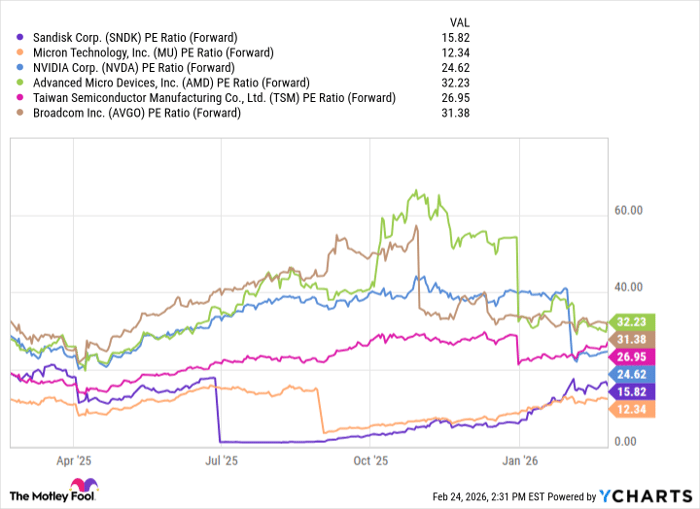
SNDK PE Ratio (Forward) data by YCharts.
The two trade at fairly similar forward price-to-earnings (P/E) multiples. And both trade at steep discounts to other leading AI semiconductor stocks.
While these other chip stocks have their own respective addressable market opportunities, the high-level takeaway from that relative discount is that both Micron and Sandisk appear positioned for some degree of valuation expansion as memory and storage become increasingly important pillars of the AI megatrend.
Accelerating demand will likely result in memory and storage chips remaining a bottleneck in the AI infrastructure buildout for quite some time. Against this backdrop, I think it would be prudent to own positions in both Micron and Sandisk.
Before you buy stock in Sandisk, consider this:
The Motley Fool Stock Advisor analyst team just identified what they believe are the 10 best stocks for investors to buy now… and Sandisk wasn’t one of them. The 10 stocks that made the cut could produce monster returns in the coming years.
Consider when Netflix made this list on December 17, 2004… if you invested $1,000 at the time of our recommendation, you’d have $456,188!* Or when Nvidia made this list on April 15, 2005… if you invested $1,000 at the time of our recommendation, you’d have $1,133,413!*
Now, it’s worth noting Stock Advisor’s total average return is 916% — a market-crushing outperformance compared to 194% for the S&P 500. Don’t miss the latest top 10 list, available with Stock Advisor, and join an investing community built by individual investors for individual investors.
*Stock Advisor returns as of February 27, 2026.
Adam Spatacco has positions in Alphabet, Amazon, Meta Platforms, Microsoft, and Nvidia. The Motley Fool has positions in and recommends Advanced Micro Devices, Alphabet, Amazon, Meta Platforms, Micron Technology, Microsoft, Nvidia, Taiwan Semiconductor Manufacturing, and Western Digital. The Motley Fool recommends Broadcom. The Motley Fool has a disclosure policy.
—
Blog powered by G6
Disclaimer! A guest author has made this post. G6 has not checked the post. its content and attachments and under no circumstances will G6 be held responsible or liable in any way for any claims, damages, losses, expenses, costs or liabilities whatsoever (including, without limitation, any direct or indirect damages for loss of profits, business interruption or loss of information) resulting or arising directly or indirectly from your use of or inability to use this website or any websites linked to it, or from your reliance on the information and material on this website, even if the G6 has been advised of the possibility of such damages in advance.
For any inquiries, please contact [email protected]