A Bitcoin mining pool is a group of miners who combine their computational (hash) power to boost their chances of mining new blocks. To explain more simply, the miners connect the mining hardware at the pool’s server rather than creating your own. Moreover, the pool rewards are distributed among participants based on how much hash power each provides.
Mining pools emerged as Bitcoin mining became more competitive and resource-intensive, making it difficult for smaller, solo miners to earn consistent rewards. Without considering the expense of energy and power supplies, the user would need considerable resources and capital to earn a consistent, lucrative reward.
Mining pools also enhance network security by increasing the number of miners involved, maintaining decentralization, and preventing any one entity from dominating the blockchain.
It’s a tough market out there for miners, given how fierce the competition is, which is why most would opt for pool mining due to steadier returns while still contributing to the network’s security and decentralization. But, like anything in life, there are a few pros and cons to each:
Solo mining pros:
And cons:
Pool mining pros:
And cons:
Now that the basics have been explained, it’s time to dive a bit deeper into the specifics. To explain how Bitcoin mining works, let’s use setting up and joining a BTC mining pool as an example.
Most Bitcoin miners use ASIC devices, like an Antminer S19 or S9, because traditional GPUs and CPUs are no longer profitable for BTC mining. The mining rig should meet current efficiency standards to stay competitive.
Moving on, match your power supply unit (PSU) to the miner’s power draw. For instance, an Antminer S9 can consume approximately 1,375 watts, so a robust and reliable PSU is essential.
Next, set up a stable, wired Ethernet connection (recommended) to minimize downtime and ensure your rig can communicate consistently with the pool’s servers. This is because your shares (i.e., your units of work to prove your contribution to solving the cryptographic puzzle) must be submitted as quickly as possible, and wireless connections may experience interruptions due to multiple elements (physical obstacles, high latency, inconsistent bandwidth due to network congestion, etc.).
Naturally, you want to plug in the miner and the PSU and connect an Ethernet cable to your local network. The next step is to use a network scanner, like Angry IP Scanner, to find your miner on your local network.
The tool will scan your network and show the IP addresses of all connected devices. Find the miner’s IP address and enter it into a web browser to open its control panel. Miners have default login details, often “root/root” username and password, but you may want to immediately change these credentials for security so no one else can access your miner.
New miners should research pools based on fees, payout schemes, security measures, and server geography. Some of the best Bitcoin mining pools include F2Pool, Foundry USA Pool, and Slush Pool.
Once you’ve selected a pool, you must create your worker credentials, which are basically your username and password. Your username (should be) often a combination of your pool account name and an optional “worker” identifier (e.g., account_name.worker_name), but the password can be of any value (or the one suggested by the mining pool).
Next, check the pool’s website and go to the dashboard to check the list of Stratum addresses. This is a URL protocol that your miner will use to submit work and receive tasks. While mining pools offer a general/default Stratum URL, ideally, you want to choose the closest server geographically due to lower latency and better efficiency.
For example, in North America, it should be something like this:
stratum+tcp://btc-na.f2pool.com:3333.
In your rig’s control dashboard, go to miner configuration or settings and enter the Stratum address specific to your chosen mining pool, along with your pool username and password.
After saving, your miner will begin directing its hashing power toward the pool.
Connect your Bitcoin wallet address to the pool. This can be part of your account profile on the pool’s website. Some pools allow participants to set a minimum payout threshold, controlling how often their earnings are sent to their wallets.
If you don’t have one already, check out our guide on some of the best Bitcoin wallets in 2025, from hot to cold solutions.
After it is configured, your miner will send shares (the units of work) to the pool, which aggregates all participants’ hashing power to find valid blocks. In return, you receive a percentage of block rewards proportional to your contribution. The more you contribute, the more you are rewarded.
You can monitor your miner’s performance either through its own interface or the pool’s website.
There are three types of payout models for rewards. Each approach involves specific trade-offs concerning fees, rewards, and risk:
Choosing a reward distribution model is as important as choosing the right pool. There are four main points to consider: risk tolerance, fees, mining goals, and dependency on operators, which can be summarized as follows:
Generally speaking, there are two reasons why a miner would choose PPs or FPPS: either they have limited resources, or they want predictable, steady income. However, those with substantial hashing power and resources often gravitate toward PPLNS because of the bigger yields. This maximizes overall earnings in times of bullish market activity but accepts some short-term uncertainty, all in exchange for the biggest rewards.
When using a BTC mining pool, there are three main risks miners should be aware of.
It’s no secret that large pools can dominate the share of the Bitcoin network’s total hashrate. Such a concentration of power defeats the purpose of decentralization, as a few entities wield increased influence over transaction validation and block production.
Another risk to consider is chain and pool manipulation. Pools may commit certain unethical practices, like withholding valid blocks to gain an advantage or censoring specific transactions to compromise the network’s security and trustworthiness. Moreover, operators hold significant control over reward distribution, and those dishonest may manipulate payouts, delay rewards, or even vanish with participants’ funds (in what is known as an exit scam).
When assessing any mining pool, it’s prudent to verify its track record of uptime, the security measures in place, such as advanced Distributed Denial-of-Service (DDoS) protection, and its history of handling potential threats. In that sense, a secure and dependable pool protects your earnings and operational consistency.
A pool experiencing repeated disruptions (DDoS attacks, most often) can lead to server downtime, impacting profits. For instance, in 2020, Poolin, one of the largest Bitcoin mining pools at the time, suffered a DDoS attack in which the pool’s servers were flooded with malicious traffic. This caused downtime and a loss of revenue for participating miners.
In addition to the above, researching a pool’s reputation and transaction history is always a fundamental step before joining one.
But even so, there’s no guarantee that a reputable mining pool won’t engage in questionable behavior. For instance, F2Pool, a leading miner in terms of network hashrate, drew criticism back in 2023 when it began filtering transactions linked to addresses sanctioned by the US Office of Foreign Assets Control (OFAC). It was found that the pool excluded specific transactions from its blocks, imposing external compliance measures within what is intended to be a neutral, decentralized network.
Needless to say, this action ran counter to Bitcoin’s principle of censorship resistance, sparking community backlash. F2Pool eventually halted its filtering patch, but the point remains the same.
Some of the top Bitcoin mining pools are listed below, according to their hashpower, popularity, payouts and fees, security, and key features, among other crucial considerations.
Foundry USA is the largest Bitcoin pool in 2025, controlling over 30% of the network hashrate.
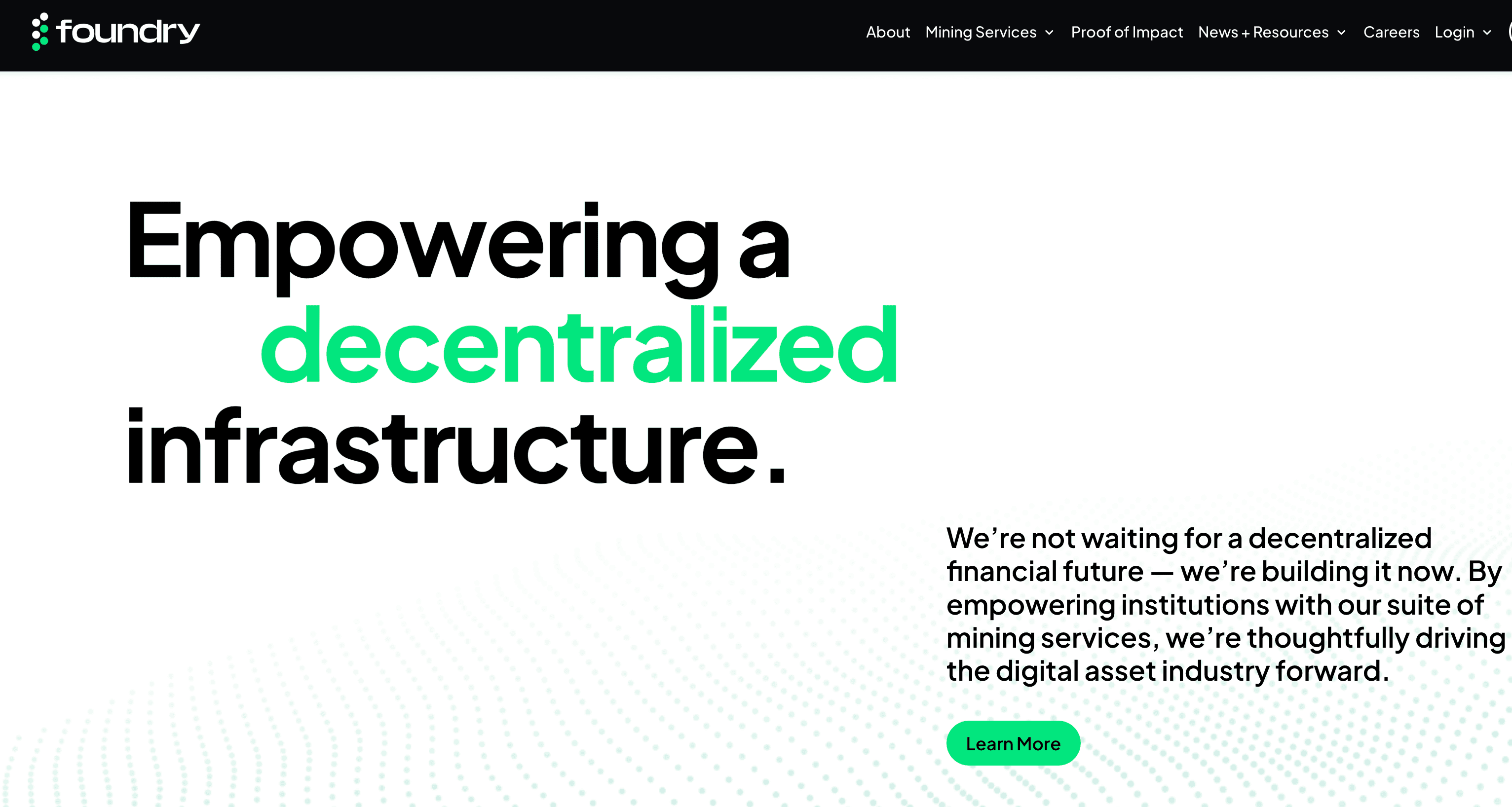
Foundry USA has a tiered structure that adjusts rates according to a miner’s quarterly average hashrate. Deductions come from the FPPS payouts, including newly minted Bitcoin, e.g., block subsidies and transaction fees. Under FPPS, miners benefit from regular and predictable payments credited daily.
Moreover, a 0.001 BTC minimum payout threshold makes Foundry approachable for smaller-scale operations, allowing frequent distributions even for those not contributing massive amounts of hash power.
Foundry USA is the largest mining pool, contributing roughly 277 to 280 EH/s to the Bitcoin network. This means it finds blocks quickly, providing reliable payouts for participating miners.
The pool supports various popular ASIC miners, including Antminer S19 models, WhatsMiner M50 series, and AvalonMiner rigs.
Pros explained:
Cons explained:
AntPool, launched by Bitmain Technologies in 2014, remains one of the most influential Bitcoin mining pools.

As of early 2025, it commands close to 19% of the network’s total hashrate, providing miners with a robust infrastructure and multiple reward structures. Although primarily focused on Bitcoin, AntPool also supports other proof-of-work cryptocurrencies.
AntPool offers three payout schemes, and they come with varying fees, influencing individual earnings:
Miners receive payouts once they exceed the 0.001 BTC threshold. Distributions occur daily after that balance is reached.
With a reported output of approximately 132.7 EH/s, AntPool contributes close to 19% of the total Bitcoin network hashrate. AntPool accepts many ASIC miners, including Bitmain’s Antminer series (S19 Pro, S19 XP), WhatsMiner (M50), and AvalonMiner devices. Although it is developed by Bitmain, other SHA-256 ASIC rigs can connect without issue.
Pros explained:
Cons explained:
ViaBTC is one of the best crypto mining pools, with a reputation for robust infrastructure, extensive coin support, and a vast suite of resources and tools for miners.
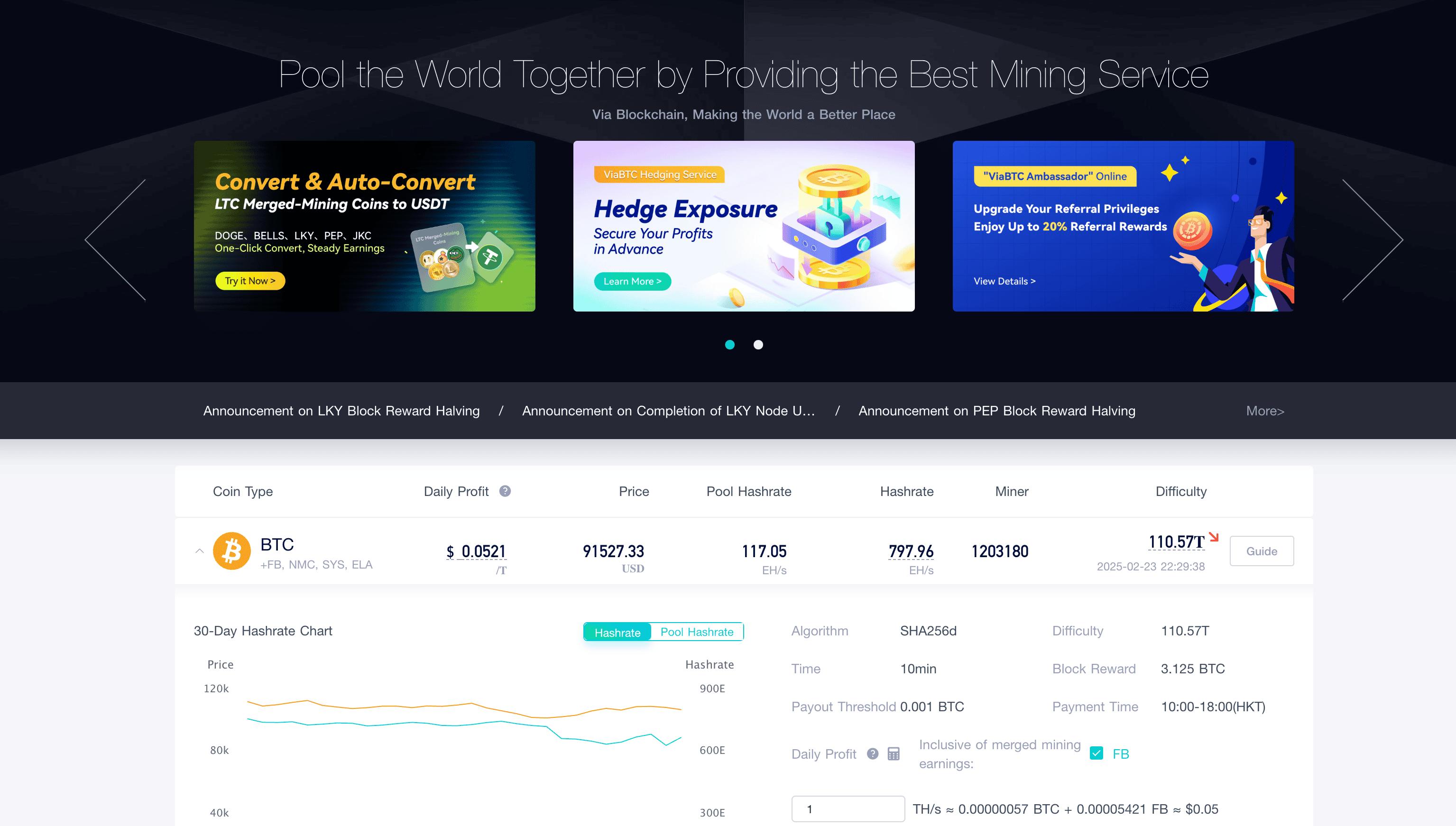
Headquartered in China, it has become the third-largest Bitcoin mining pool globally, holding about 14% of the network’s hashrate as of early 2025. In addition to BTC, ViaBTC covers numerous other PoW cryptocurrencies.
ViaBTC offers PPS and PPLNS for miners, charging 4% and 2%, respectively.
ViaBTC contributes around 83.5 EH/s, accounting for approximately 14% of Bitcoin’s total hashrate.
Moreover, ViaBTC supports ASIC miners for Bitcoin and other SHA-256 coins and GPU rigs for altcoins such as Ethereum Classic (ETC) or Zcash (ZEC). It also offers various setup guides for mining software like PhoenixMiner or T-Rex Miner.
The default minimum threshold for payouts is 0.0001 BTC, making the pool accessible to smaller-scale participants. Miners are paid once they exceed this amount, with disbursements typically processed daily.
Pros explained:
Cons explained:
Luxor Mining Pool, established in 2018, is a North American-based operation recognized for its Full Pay Per Share (FPPS) model and broad support for multiple cryptocurrencies.
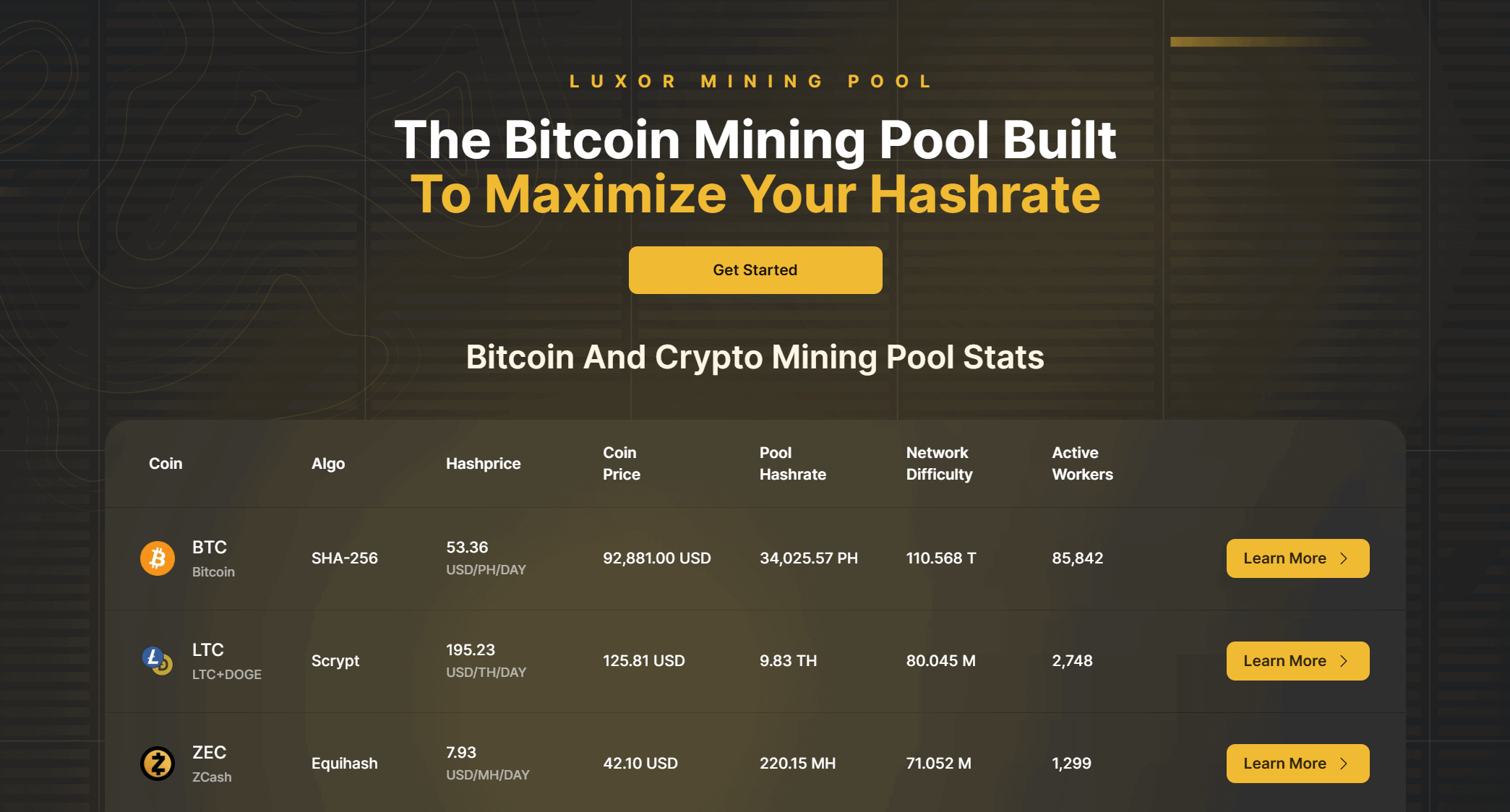
Though its Bitcoin hashrate is lower than some market-leading pools, Luxor remains a strong choice for miners seeking hourly payouts, competitive fees, and extra services like Catalyst, which allows mining altcoins but receiving rewards in Bitcoin.
The pool charges a fee of 0.7% for Bitcoin, only under the FPPS system, with consistent hourly payouts based on submitted shares, including block rewards and transaction fees. For altcoins, the fee structure may vary, as some altcoins use PPS or PPLNS models (occasionally at 0% for PPLNS).
Luxor’s 0.7% fee under FPPS compares favorably against other major pools, especially those with higher percentages for full pay-per-share payouts.
Luxor contributes an estimated 20 EH/s to the Bitcoin network, which puts it behind some larger competitors yet keeps it influential in North America.
The pool works with leading ASIC miners:
GPU mining is also supported under the Catalyst feature for certain altcoins. The minimum Bitcoin payout is 0.004 BTC.
Pros explained:
Cons explained:
F2Pool is among the market’s longest-running and most diverse cryptocurrency mining pools. Established in 2013, it supports over 40 digital assets, including Bitcoin, Ethereum PoW (ETHW), Litecoin (LTC), and many more.
Alongside its broad coin coverage, F2Pool offers a range of payout structures (PPS+, FPPS, and PPLNS), daily automatic distributions, and strong security features to safeguard miners’ earnings.
2FPool offers three types of payment methods, depending on the user’s need: PPS+, FPPS, and PPLNS.
F2Pool’s Bitcoin mining fees vary based on the payout model, generally ranging from 2% for PPLNS to 4% for FPPS. Although this may be slightly higher than smaller pools, many miners find the stability and reliability worthwhile. Again, it all depends on the user’s goals and needs.
Bitcoin miners can expect a minimum payout of 0.005 BTC by default, which they can adjust in their account settings to suit their preferences.
F2Pool provides about 10% of the total Bitcoin network hashrate in 2025, translating into roughly 81.4 EH/s. This means the pool often finds blocks relatively quickly. Moreover, most modern ASIC devices, like the Antminer S19 series, are compatible, and F2Pool also accommodates GPU mining for certain altcoins.
Pros explained:
Cons explained:
The post The 5 Best Bitcoin Mining Pools in 2025: Complete Guide appeared first on CryptoPotato.
—
Blog powered by G6
Disclaimer! A guest author has made this post. G6 has not checked the post. its content and attachments and under no circumstances will G6 be held responsible or liable in any way for any claims, damages, losses, expenses, costs or liabilities whatsoever (including, without limitation, any direct or indirect damages for loss of profits, business interruption or loss of information) resulting or arising directly or indirectly from your use of or inability to use this website or any websites linked to it, or from your reliance on the information and material on this website, even if the G6 has been advised of the possibility of such damages in advance.
For any inquiries, please contact [email protected]