While they don’t expect it this month, traders are betting on a quarter-point rate hike in December.
The higher interest rates meant to curb inflation could also result in crimped corporate profit growth.
Yet, presuming you can predict changes to interest rates might end up doing you more harm than good.
In just a few days — on Oct. 28, to be precise – the Federal Reserve’s Open Market Committee will make a decision about the federal funds rate.
Despite September’s quarter-point increase, meant to curb the inflation that’s clearly still lingering, interest rate futures data from exchange CME Group says there’s a 90% chance the FOMC will leave the fed funds rate’s current target range of 3.75% to 4% alone, with only a 10% chance the committee will raise this target range by another quarter point.
Missed AI’s “Act 1”? Act 2 Could Be 15x Bigger. Most investors think they missed the AI boat because they didn’t buy Nvidia in 2005. But according to our analysts, we’re only at the end of “Act 1″—the R&D phase. “Act 2” is the global rollout. Continue »
Don’t think we’re off the hook just yet, however.
The Fed’s Open Market Committee (FOMC) has one more scheduled opportunity after the one later this month to raise interest rates in 2026. That’s on Dec. 9. And as it stands, the market is betting on a rate hike then. Specifically, interest rate futures indicate there’s a 76% chance of a quarter-point increase in the fed funds rate being made at that time, while there’s a 9% chance the FOMC will raise its target range for this baseline interest rate by half a point, to between 4.25% and 4.5%.
The question is, of course, how might another likely rate hike affect investors? Let’s have a look.
There’s no getting around the fact that higher interest rates can work against stocks. Price inflation reflects strong consumer and corporate spending, but too much inflation for too long can take a toll on the economy. Raising the cost of borrowing curbs this price-increasing demand, but since it also dials back corporate profit growth, it in turn reduces stocks’ perceived value. History even shows some market setbacks corresponding with rate hikes.

Image source: Getty Images.
Just don’t lose perspective on any of it. Knee-jerk bearish reactions are often short-lived; high or rising interest rates don’t inherently coincide with prolonged market weakness, if there’s any weakness at all.
It’s certainly possible to see both at the same time. And you sometimes will. Not always, though, and not predictably enough that you should take the chance of being out of the stock market when you’d be better served by staying in.
Periods like 2004 to 2007 and 2016 to 2019 come to mind. Although the S&P 500 (SNPINDEX: ^GSPC) eventually peaked with interest rates at the ends of those stretches, the gains made in the few years leading up to those peaks were too significant to pass up even if they ended with pullbacks.
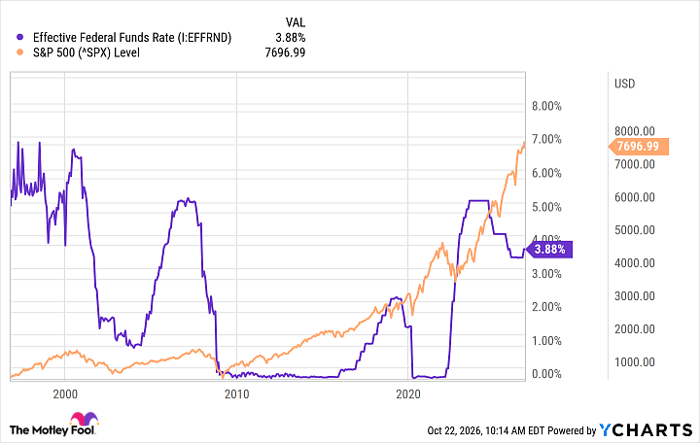
Effective Federal Funds Rate data by YCharts
The point is, don’t jump to a sweeping conclusion about any rate hike made in October, or, more plausibly, in December. It would be only a small part of a much bigger and more complex backdrop that determines the stock market’s long-term direction.
More to the point, what investors should do right now about the potential rate hike sometime before the end of this year is absolutely nothing. Just stay focused on finding, buying, and holding quality stocks. Doing that tends to take care of any short-term setbacks.
Before you buy stock in S&P 500 Index, consider this:
The Motley Fool Stock Advisor analyst team just identified what they believe are the 10 best stocks for investors to buy now… and S&P 500 Index wasn’t one of them. The 10 stocks that made the cut could produce monster returns in the coming years.
Consider when Netflix made this list on December 17, 2004… if you invested $1,000 at the time of our recommendation, you’d have $355,124!* Or when Nvidia made this list on April 15, 2005… if you invested $1,000 at the time of our recommendation, you’d have $1,296,254!*
Now, it’s worth noting Stock Advisor’s total average return is 901% — a market-crushing outperformance compared to 210% for the S&P 500. Don’t miss the latest top 10 list, available with Stock Advisor, and join an investing community built by individual investors for individual investors.
*Stock Advisor returns as of October 26, 2026.
James Brumley has no position in any of the stocks mentioned. The Motley Fool has positions in and recommends CME Group. The Motley Fool has a disclosure policy.
—
Blog powered by G6
Disclaimer! A guest author has made this post. G6 has not checked the post. its content and attachments and under no circumstances will G6 be held responsible or liable in any way for any claims, damages, losses, expenses, costs or liabilities whatsoever (including, without limitation, any direct or indirect damages for loss of profits, business interruption or loss of information) resulting or arising directly or indirectly from your use of or inability to use this website or any websites linked to it, or from your reliance on the information and material on this website, even if the G6 has been advised of the possibility of such damages in advance.
For any inquiries, please contact [email protected]