Vexl: Empowering Peer-to-Peer Bitcoin Exchange Through Social Networks
CEO Viliam Klamarcik explains how Vexl’s web-of-trust model and end-to-end encryption prioritize privacy in peer-to-peer Bitcoin trading.
This post Vexl: Empowering Peer-to-Peer Bitcoin Exchange Through Social Networks first appeared on Bitcoin Magazine and is written by Juan Galt.
Bitcoin Magazine
Vexl: Empowering Peer-to-Peer Bitcoin Exchange Through Social Networks
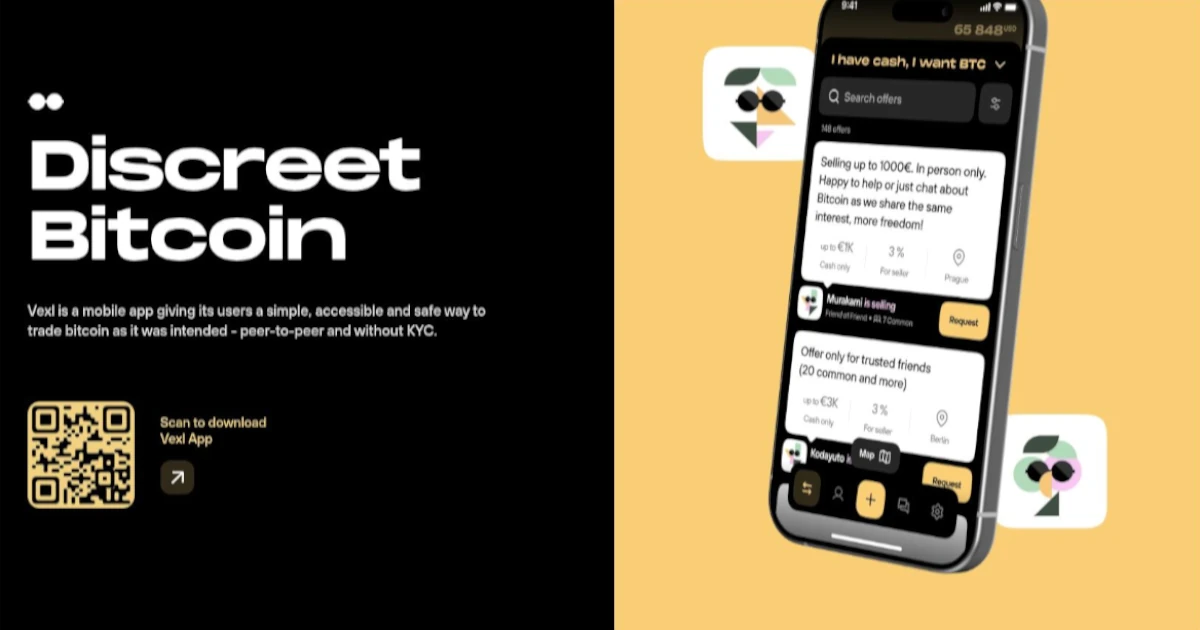
In an era where centralized exchanges dominate cryptocurrency trading, Vexl stands out as a peer-to-peer (P2P) application designed to connect Bitcoin users within their personal networks for direct, non-custodial trades. The app facilitates buying and selling Bitcoin without intermediaries, emphasizing in-person meetings for cash exchanges while also supporting fiat transfers arranged privately between users.
As Viliam Klamarcik, CEO of Vexl, explained in an interview with Bitcoin Magazine, “we are an application that helps people to buy and sell Bitcoin directly with each other, without any intermediaries, without KYC. Vexl works without custody, so peer-to-peer, but what’s most important is that it is always within your own community, meaning we are not a global marketplace. We are basically a peer-to-peer notice board where you can connect with your first and second-level connections.”
At its core, Vexl prioritizes privacy, functioning as a high-trust notice board within your personal social network, rather than an exchange. It does not escrow Bitcoin or fiat, it does not hold user funds, nor store balances, messages, or personal data. All communications occur via end-to-end encrypted chats, and trades happen off-app, placing responsibility on users to verify counterparts. This design aligns with Vexl’s mission to support non-KYC Bitcoin acquisition and local economies, as confirmed on the app’s official website, which states, “We do not store any personal information or any of your messages, period.”
User connections in Vexl are built on a web-of-trust model, drawing from imported phone contacts to create a personalized order book. Offers are visible only to first- and second-degree connections—your contacts and their contacts—enhancing liquidity while maintaining high trust through shared social links. This limits exposure to strangers, reducing scam risks, and usernames remain anonymous until users mutually reveal identities. Klamarcik noted, “The biggest difference between Vexel and the other applications is, first of all, its web of trust, which means you don’t trade with users; you trade with people with whom you are connected through real social links.” The app’s privacy measures include hashing contact data and separating components like profiles, chats, offers, and contacts into microservices that converge only on the user’s device, ensuring no centralized database exists.
To enable this system, Vexl requires a phone number for registration, serving as proof of humanity to deter bots and facilitating contact imports. Privacy concerns are addressed through encryption and hashing; as the website affirms, “Your chats always remain encrypted, while the phone numbers are hashed.” Klamarcik acknowledged imperfections but emphasized its necessity: “The phone numbers are a big topic, and we are aware of that. And it’s not perfect, but also it’s probably the best solution that we have out there to build trust upon that.” This mirrors mechanisms in apps like Signal and major social networks, primarily as a spam-prevention and authentication tool.
For users hesitant to import full contacts—particularly in privacy-focused regions like Germany—Vexl offers “clubs,” curated groups managed by local moderators, often meetup organizers. These act as public rooms where members can view offers without broad network sharing, though trust shifts to the moderator. Entry requires a one-time code or QR scan, regenerable for security, providing an onboarding boost for newcomers until they build direct connections.
Vexl is available on both Android and iOS, but iOS users face restrictions. The app is not officially listed on the App Store, limited to TestFlight beta slots or sideloading in the EU, due to Apple’s claims of “reckless behavior” for encouraging in-person trades (Tinder, however, remains in iOS without restrictions). Android offers seamless access via Google Play or APK downloads, making it the optimal platform for unrestricted use.
Vexl runs under a non-profit foundation model, accepting donations and grants to preserve its privacy and peer-to-peer ethos. On the topic, Klamarcik said, “From the very beginning, Vexl was intended as a gift to the Bitcoin community: an open-source tool built to help people transact peer-to-peer, without custody, surveillance, or extracting value from users. The project operates as a non-profit with an essential goal in its core – to keep bitcoin usable in everyday life and accessible to anyone, anywhere. Funding through donations and grants allows Vexl to stay focused on building simple, resilient tools for freedom. As an open-source project supported by SatoshiLabs, the creators of the Trezor hardware wallet, Vexl follows a long tradition of building infrastructure first.” Vexl is fully open source and is a project by Satoshi Labs, the creators of the Trezor hardware wallet.
The non-profit model has become increasingly popular among privacy-focused projects, as for-profit incentives tend to lead to data collection business models like advertisement, while Bitcoin-specific privacy apps have been actively prosecuted on the basis of monetizing “money laundering”. Samourai Wallet’s founders were accused of money laundering conspiracy, though ultimately were only imprisoned for unlicensed money transmission charges, after facilitating over $2 billion in transactions via a non-custodial Bitcoin wallet. Tornado Cash faced U.S. sanctions in 2022 for billions in volume, under similar charges for a service that profited from giving Ethereum users basic financial privacy. These cases highlight how privacy-focused entities are being targeted by governments.
Looking ahead, Klamarcik signaled expansion: “This year is hopefully going to be the year when we actually go overseas and also focus on markets outside of Europe when it makes sense.”
This post Vexl: Empowering Peer-to-Peer Bitcoin Exchange Through Social Networks first appeared on Bitcoin Magazine and is written by Juan Galt.
—
Blog powered by G6
Disclaimer! A guest author has made this post. G6 has not checked the post. its content and attachments and under no circumstances will G6 be held responsible or liable in any way for any claims, damages, losses, expenses, costs or liabilities whatsoever (including, without limitation, any direct or indirect damages for loss of profits, business interruption or loss of information) resulting or arising directly or indirectly from your use of or inability to use this website or any websites linked to it, or from your reliance on the information and material on this website, even if the G6 has been advised of the possibility of such damages in advance.
For any inquiries, please contact [email protected]