The Vanguard Emerging Markets Government Bond ETF is vulnerable to risk from the Iran War, with 27% of its bond holdings in Middle East countries.
Emerging market bonds and currencies tend to decline during times of global crisis and an investor “flight to safety” — but the reverse can also be true.
The Vanguard Emerging Markets Government Bond ETF (NASDAQ: VWOB) has been on an impressive winning streak recently, with average annual returns (by net asset value) of 8.2% for the past three years. That’s a good sign of investor confidence that developing countries will grow their economies and repay their debts.
Unfortunately, emerging markets have been hit hard by the Iran War. After the Iran War started on Feb. 28, share prices of this international bond ETF declined by about 5% in a month. Let’s look at a few reasons why VWOB is struggling, and why an end to the Iran War could be especially beneficial for emerging market bonds.
Will AI create the world’s first trillionaire? Our team just released a report on the one little-known company, called an “Indispensable Monopoly” providing the critical technology Nvidia and Intel both need. Continue »
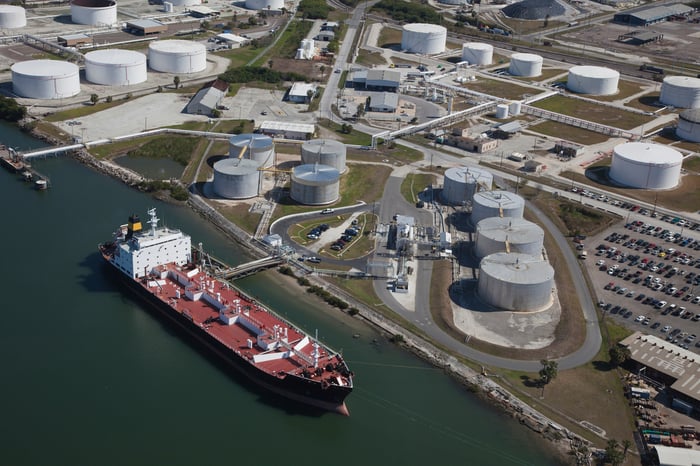
Image source: Getty Images.
Energy company infrastructure throughout the Middle East has been hit by missiles and drone strikes. Daily oil shipments through the strategically important Strait of Hormuz have been largely cut off for weeks. These sudden reductions in oil and gas supply have caused shocking spikes in energy prices.
Higher energy costs are particularly bad news for developing countries that don’t have their own supplies of oil and natural gas. For example, many Asian countries are highly reliant on oil and gas imports from the Middle East. The Iran War has caused fuel shortages and protests in several of these countries.
The Vanguard Emerging Markets Government Bond ETF also owns bonds from several countries in the Middle East that are directly at risk from the Iran War. The bond ETF’s top holdings include government debt from Saudi Arabia (13.4% of the fund), United Arab Emirates (5.5%), Qatar (3.8%), Bahrain (2%), Oman (1.5%), and Kuwait (1.2%).
That’s a total of 27.4% of this fund that’s directly exposed to the risk of Iranian drone strikes and missile attacks.
March 27 was a recent low point for the price of VWOB. But as prospects for peace with Iran have improved in the past few weeks, the international bond ETF has gained about 2.6% since hitting that low. If the Iran War can end in a way that brings back the flow of oil from the Strait of Hormuz, that would be good news for this international bond ETF.
But there are no guarantees that the Iran War will truly be over anytime soon, or that oil shipments from the Middle East will go back to normal in way that helps emerging markets. News headlines have whipsawed back and forth about Iran War ceasefires and negotiations and blockades.
VWOB had a good run for the past three years, but there’s too much uncertainty for me to rate this bond ETF as a buy today.
Before you buy stock in Vanguard Emerging Markets Government Bond ETF, consider this:
The Motley Fool Stock Advisor analyst team just identified what they believe are the 10 best stocks for investors to buy now… and Vanguard Emerging Markets Government Bond ETF wasn’t one of them. The 10 stocks that made the cut could produce monster returns in the coming years.
Consider when Netflix made this list on December 17, 2004… if you invested $1,000 at the time of our recommendation, you’d have $556,335!* Or when Nvidia made this list on April 15, 2005… if you invested $1,000 at the time of our recommendation, you’d have $1,160,572!*
Now, it’s worth noting Stock Advisor’s total average return is 975% — a market-crushing outperformance compared to 193% for the S&P 500. Don’t miss the latest top 10 list, available with Stock Advisor, and join an investing community built by individual investors for individual investors.
*Stock Advisor returns as of April 14, 2026.
Ben Gran has no position in any of the stocks mentioned. The Motley Fool has no position in any of the stocks mentioned. The Motley Fool has a disclosure policy.
—
Blog powered by G6
Disclaimer! A guest author has made this post. G6 has not checked the post. its content and attachments and under no circumstances will G6 be held responsible or liable in any way for any claims, damages, losses, expenses, costs or liabilities whatsoever (including, without limitation, any direct or indirect damages for loss of profits, business interruption or loss of information) resulting or arising directly or indirectly from your use of or inability to use this website or any websites linked to it, or from your reliance on the information and material on this website, even if the G6 has been advised of the possibility of such damages in advance.
For any inquiries, please contact [email protected]