Anthropic’s Claude Cowork plugins leverage agentic AI to complete tasks that have previously been performed by human workers.
The advanced capabilities of Cowork mimic many of those found in legacy enterprise software platforms.
Investors are worried that Claude poses an existential threat to once-dominant software businesses.
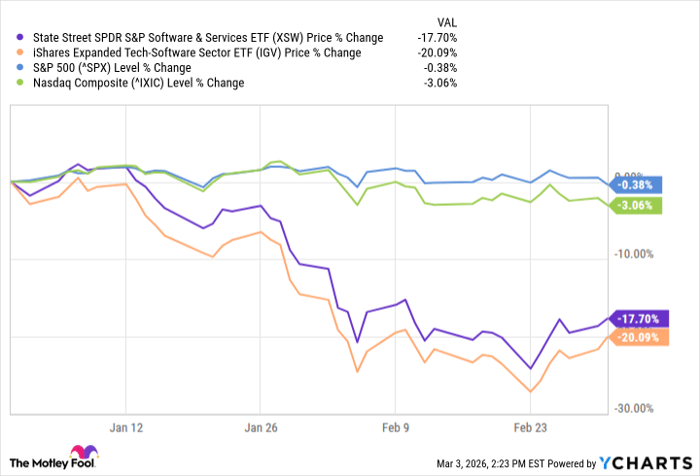
After a historic bull run between 2023 and 2025, the technology sector has taken it in the shins so far this year. In particular, software stocks have been plummeting relative to broader indexes like the S&P 500 and Nasdaq Composite.
Will AI create the world’s first trillionaire? Our team just released a report on the one little-known company, called an “Indispensable Monopoly” providing the critical technology Nvidia and Intel both need. Continue »
With the way things are trending, the “SaaSpocalypse” doesn’t appear to have an end in sight. But based on the forces driving enterprise software stock down now, is this an opportunity to buy the dip or a sign to run for the hills?
The main catalyst for the recent decline in software-as-a-service (SaaS) stocks has come from artificial intelligence (AI) start-up Anthropic. Anthropic has developed a large language model (LLM) called Claude, much like OpenAI’s ChatGPT.
Over the last month, Anthropic has released a number of tools within its enterprise ecosystem, called Cowork. Within Claude Cowork, Anthropic offers tools spanning workplace productivity, customer relationship management (CRM), coding, project management, human resources, finance operations, and more.
The value proposition of Cowork is that it is designed to provide its users with an autonomous virtual workforce. In other words, once Claude has been handed a broad job, a human will not need to manually prompt it to perform the individual tasks that are part of it. Rather, these new models leverage agentic AI capabilities to interact directly with operating systems and data sets to complete workflows.

Image source: Getty Images.
Since Anthropic released Cowork in mid-January, a number of high-profile SaaS stocks have cratered.
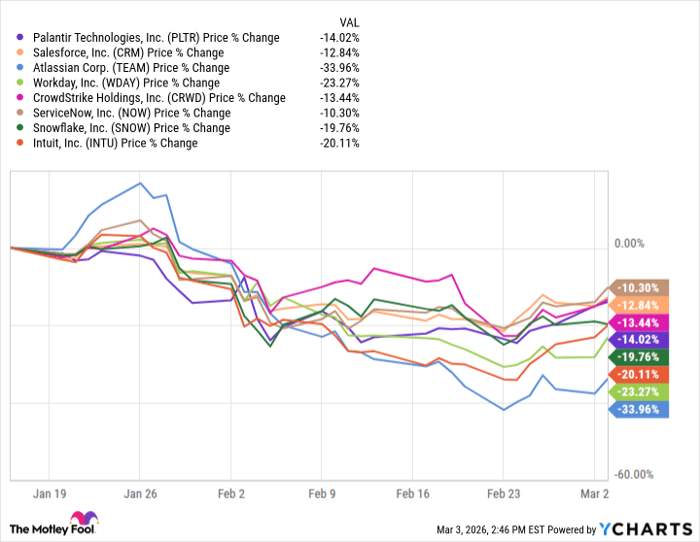
Broadly speaking, SaaS stocks have commanded valuation premiums due to the predictable, high-margin nature of their businesses. However, Claude Cowork is single-handedly disrupting this narrative.
Companies such as Palantir Technologies (NASDAQ: PLTR), Salesforce, Intuit, Workday, and CrowdStrike spent decades building high barriers to entry in their respective SaaS verticals.
Nevertheless, Anthropic’s ability to deploy AI agents that can understand, process, and reason through complex workflows without human intervention is beginning to call into question the growth prospects of incumbent software providers.
The obvious question plaguing AI investors right now is whether the software sell-off is overblown or warranted. In my view, the answer is nuanced.
Take Salesforce and Intuit as prime examples. While both are fairly diversified businesses, each is primarily known for only one thing: CRM (Salesforce) and financial budgeting (Intuit). Software products in both niches are pretty commoditized — there’s already no shortage of smaller, cheaper, and industry-specific platforms trying to compete with them.
Given these dynamics, I can understand why investors may have some doubts over single-point-solution businesses. Another way of saying this is if an AI agent can perform the same deliverables as an entire sales or finance department, then why would a corporation continue paying hefty, per-seat subscription fees for each worker when it could buy universal access to the Claude Cowork suite?
I expect that the companies that will emerge relatively unscathed from the SaaSpocalypse will be the ones with the most specialized solutions and the most valuable proprietary data. In that respect, Anthropic’s innovations have changed the SaaS landscape insofar as the long-term winners may not be the ones boasting the most seat licenses or the highest billings today, but rather the ones that are able to integrate their software with agentic models to the best advantage.
Against this backdrop, I see names such as Palantir, CrowdStrike, and ServiceNow as compelling opportunities to buy and hold during the ongoing software sector correction. I do not see Claude Cowork diminishing the addressable markets for companies in industries such as cybersecurity, IT services, specialized data mining, or stealth defense operations.
This is all to say that investors should not buy the dip in software stocks blindly. This is a time to be smart and cautious, as each of the stocks discussed will likely continue exhibiting some degree of volatility as the agentic AI chapter continues to be written.
Before you buy stock in Palantir Technologies, consider this:
The Motley Fool Stock Advisor analyst team just identified what they believe are the 10 best stocks for investors to buy now… and Palantir Technologies wasn’t one of them. The 10 stocks that made the cut could produce monster returns in the coming years.
Consider when Netflix made this list on December 17, 2004… if you invested $1,000 at the time of our recommendation, you’d have $534,008!* Or when Nvidia made this list on April 15, 2005… if you invested $1,000 at the time of our recommendation, you’d have $1,090,073!*
Now, it’s worth noting Stock Advisor’s total average return is 949% — a market-crushing outperformance compared to 190% for the S&P 500. Don’t miss the latest top 10 list, available with Stock Advisor, and join an investing community built by individual investors for individual investors.
*Stock Advisor returns as of March 9, 2026.
Adam Spatacco has positions in Palantir Technologies. The Motley Fool has positions in and recommends Atlassian, CrowdStrike, Intuit, Palantir Technologies, Salesforce, ServiceNow, Snowflake, and Workday. The Motley Fool has a disclosure policy.
—
Blog powered by G6
Disclaimer! A guest author has made this post. G6 has not checked the post. its content and attachments and under no circumstances will G6 be held responsible or liable in any way for any claims, damages, losses, expenses, costs or liabilities whatsoever (including, without limitation, any direct or indirect damages for loss of profits, business interruption or loss of information) resulting or arising directly or indirectly from your use of or inability to use this website or any websites linked to it, or from your reliance on the information and material on this website, even if the G6 has been advised of the possibility of such damages in advance.
For any inquiries, please contact [email protected]