The S&P 500 has rebounded this month, but it still exposed its vulnerability in February and March.
The economic dynamic that’s allowed the U.S. market to lead is on the verge of undergoing a serious shift.
There’s no need to get out of U.S. stocks, but investors should strategically add some exposure to foreign shares.
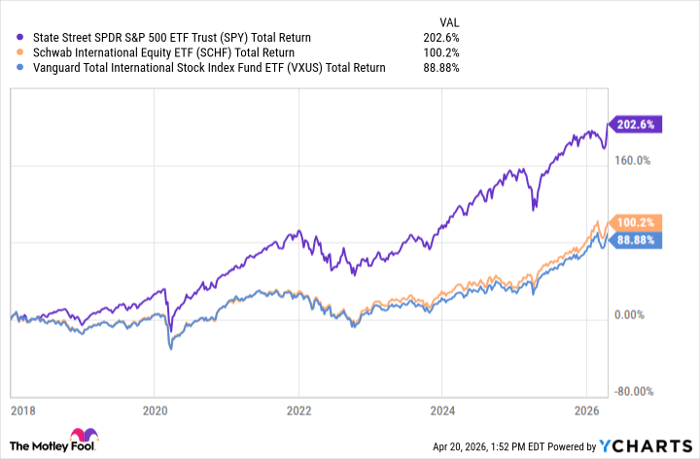
For the better part of the past couple of decades, a portfolio of American stocks offered U.S. investors more than enough diversification. Adding foreign stocks to the mix, in fact, would have resulted in underperformance.
Will AI create the world’s first trillionaire? Our team just released a report on the one little-known company, called an “Indispensable Monopoly” providing the critical technology Nvidia and Intel both need. Continue »
SPY Total Return Level data by YCharts
As the old adage goes, though, nothing lasts forever. Despite the recent heroic recovery of most domestic growth stocks, investors would be wise now to make a point of adding some international exposure to their holdings here, for a couple of reasons.
The first reason is the most obvious one. That’s the likely fallout from the military conflict between the United States and Iran.
Regardless of where you may stand on the underlying issue itself, there’s no denying it’s proving costly in terms of funding it, as well as in terms of disrupting international trade. Already forming strategic alliances in response to new import (into the U.S.) tariffs, several nations have since deepened their trade agreements in an effort to avoid dealing with an unpredictable United States. This means less need for trade with U.S. companies themselves.
The impact of this dynamic isn’t fully realized yet. It’s still coming, though. For perspective, the International Monetary Fund recently dialed back its 2026 GDP growth outlook for the United States from an already-modest 2.4% to 2.3%, en route to an even-weaker 2.1% next year. Meanwhile, the IMF still expects worldwide GDP growth of 3.1% this year despite the global impact of the Middle East conflict.

Image source: Getty Images.
As for the other reason why international stocks are apt to outperform U.S. stocks this year, it’s got everything to do with the advent of artificial intelligence (AI) and the fact that the U.S. economy is largely driven by services — 73%, according to the Federal Reserve — and just 16% from manufacturing (with the remainder from government spending).
And it matters. As a team led by Bank of America‘s chief global strategist Michael Hartnett pointed out in February, since artificial intelligence offers far more value to factories in the form of automation and efficiency than it does to industries like restaurants or retail that are still built around interactions between employees and customers, China and other production-oriented economies can use the this tech to outpace the U.S. economy. Moreover, Hartnett and his team believe this underlying dynamic could help foreign stocks outperform domestic stocks for a full decade.
None of this is to suggest something like the United States-centric SPDR S&P 500 ETF Trust (NYSEMKT: SPY) is entirely unownable here. Indeed, you arguably should stick with a fair amount of exposure to domestic equities simply because no one really knows what the future holds.
If you want to maximize your potential upside while simultaneously minimizing your risk, though, you should make a point of stepping into a stake in something simple, like the Schwab International Equity ETF (NYSEMKT: SCHF) or the Vanguard Total International Stock ETF (NASDAQ: VXUS), neither of which holds any U.S.-based companies.
Before you buy stock in Schwab International Equity ETF, consider this:
The Motley Fool Stock Advisor analyst team just identified what they believe are the 10 best stocks for investors to buy now… and Schwab International Equity ETF wasn’t one of them. The 10 stocks that made the cut could produce monster returns in the coming years.
Consider when Netflix made this list on December 17, 2004… if you invested $1,000 at the time of our recommendation, you’d have $498,522!* Or when Nvidia made this list on April 15, 2005… if you invested $1,000 at the time of our recommendation, you’d have $1,276,807!*
Now, it’s worth noting Stock Advisor’s total average return is 983% — a market-crushing outperformance compared to 200% for the S&P 500. Don’t miss the latest top 10 list, available with Stock Advisor, and join an investing community built by individual investors for individual investors.
*Stock Advisor returns as of April 25, 2026.
Bank of America is an advertising partner of Motley Fool Money. James Brumley has no position in any of the stocks mentioned. The Motley Fool has no position in any of the stocks mentioned. The Motley Fool has a disclosure policy.
—
Blog powered by G6
Disclaimer! A guest author has made this post. G6 has not checked the post. its content and attachments and under no circumstances will G6 be held responsible or liable in any way for any claims, damages, losses, expenses, costs or liabilities whatsoever (including, without limitation, any direct or indirect damages for loss of profits, business interruption or loss of information) resulting or arising directly or indirectly from your use of or inability to use this website or any websites linked to it, or from your reliance on the information and material on this website, even if the G6 has been advised of the possibility of such damages in advance.
For any inquiries, please contact [email protected]